Go to my journey

I declare that I have acquired the information provided in the informative report on the privacy rules and I give my consent for the purposes indicated below:


Forgot password? New user? Sign up

Favourites

order by Az - type

Spoleto

PRIVATE GUIDED TREKKING TOUR
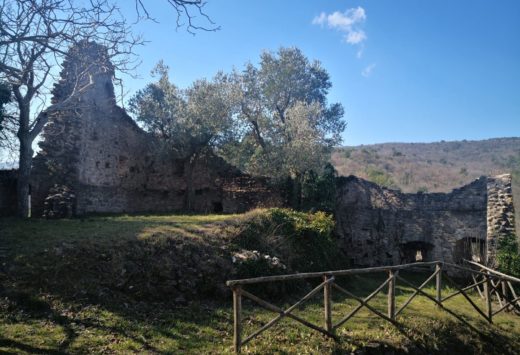
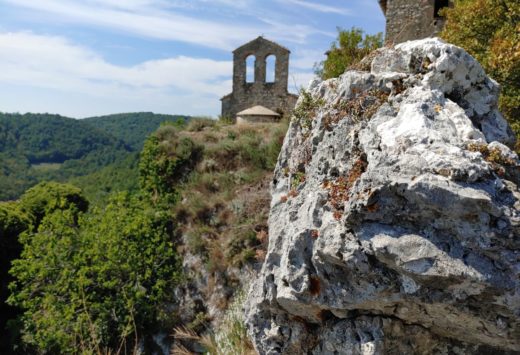
The Castle of Morcicchia

From ancient villages nestled in greenery in search of a castle and its history

from 90€ Per person
Price is lower based on umber of people
PRIVATE GUIDED MTB TOUR
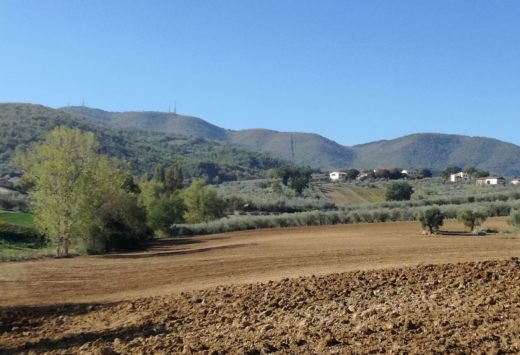
The Countryside around Giano dell’Umbria

An easy cycle ride through vineyards and olive groves at the foot of the Martani mountains

from 90€ Per person
Price is lower based on umber of people
PRIVATE GUIDED TREKKING TOUR
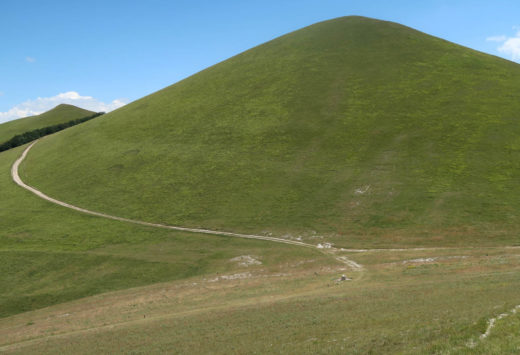
The ring of the ‘Monte Patino’ mountain

Trekking in the Sibillini mountain range, from the valley of a thousand colours to the top of Monte Patino

from 90€ Per person
Price is lower based on umber of people
EDUCATIONAL WALK
Tracking down truffles in Umbria

Come and experience a tour dedicated to one of the most popular products in Umbria: truffles!

from 95€ Per person
Price is lower based on umber of people
PRIVATE GUIDED TREKKING TOUR
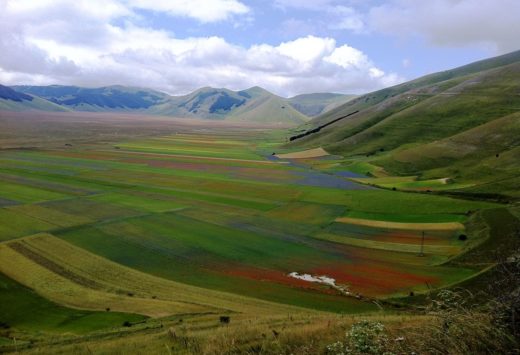
Trekking around mount Veletta and Castelluccio di Norcia

Trekking around Monte Veletta, on the hills above Castelluccio di Norcia

from 75€ Per person
Price is lower based on umber of people
PRIVATE GUIDED TREKKING TOUR
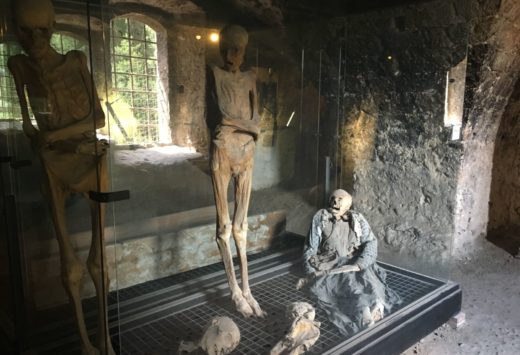
Trekking to Ferentillo: from San Michele to the mummies

Trekking to Ferentillo is an intense hiking experience in the heart of the Valnerina.

from 90€ Per person
Price is lower based on umber of people
PRIVATE GUIDED TREKKING TOUR
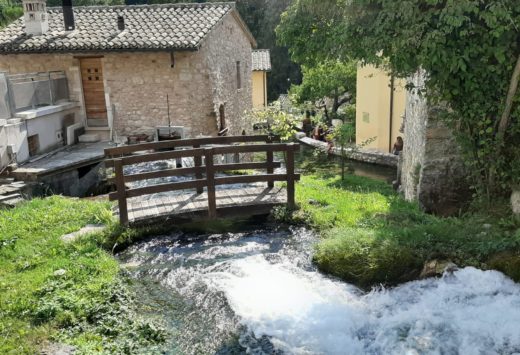
Trekking to Rasiglia and Verchiano, along the ancient road

A circular trekking excursion to discover Rasiglia, one of the most beautiful places in Umbria.

from 90€ Per person
Price is lower based on umber of people
PRIVATE GUIDED TREKKING TOUR
Trekking to Scoppio, the Ghost Town of Umbria

A uniquely beautiful trekking experience in the mysterious ghost town of Scoppio.

from 90€ Per person
Price is lower based on umber of people

What to see and what to do in Spoleto

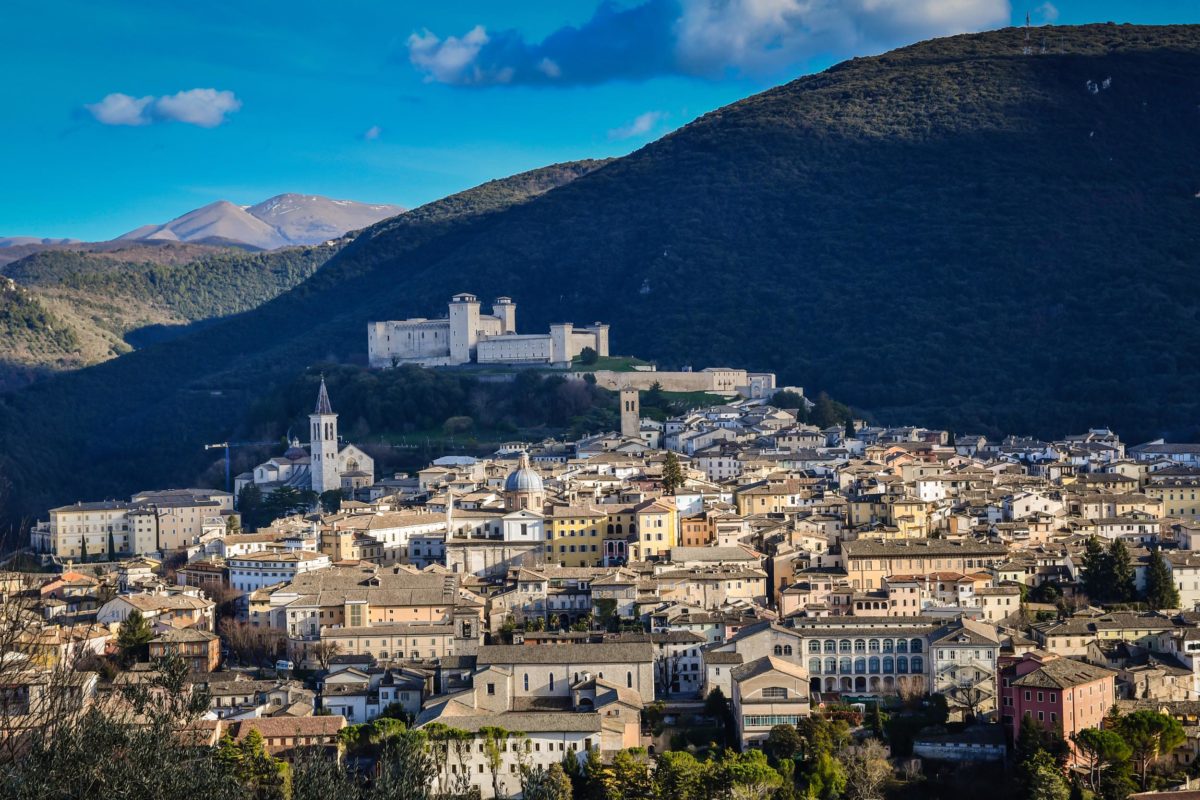
Great authors of the past such as Herman Hesse, Goethe and Stendhal dedicated parts of their works to Spoleto or mentioned it in private letters they wrote during their travels in Italy, pleasantly impressed by the beauty of this city. Before you even enter the walls, you will be fascinated by the sight of the magnificent Ponte delle Torri (Towers Bridge) which so impressed the German philosopher. The grandeur of Renaissance architecture blends harmoniously and magical-evocatively with the thick foliage of the trees that populate the dense forests of the surrounding valley. The ancient Roman vestiges, witnesses of a period of prosperity, still stand out among the medieval and modern monuments. The Rocca Albornoziana and Mount Luco are sceneries with a landscape that almost always looks like a life-size creche. Walking through the city streets, discovering the famous sculptures that have marked the artistic history of the twentieth century since 1962, enjoying the fragrance of tradition and genuine cuisine, surrounding yourself with the elaborate architecture of the countless churches that occupy all corners of the city, you will have the impression of having found one of the strongest and most important cities in all of central Italy. In fact, after the fall of the Roman Empire, the Duchy of Spoleto assumed great strategic importance in the new Italian political scenario and managed to keep the vast surrounding area under its control for several centuries. If you happen to visit the city during its most important event, the renowned Festival of Two Worlds, you will have the clear perception that despite the passage of time Spoleto has never lost its greatness!

Discovering Spoleto

Scopri cosa vedere a Spoleto, la città del Ducato.

Amate la storia antica, romana e tardomedievale? Apprezzate le forme e i decori dell’architettura religiosa, vi emozionate davanti alla natura e alla scultura e, per caso, avete anche seguito la fiction televisiva di Don Matteo con Terence Hill protagonista? Allora la visita della città di Spoleto non mancherà di regalarvi eccezionali sensazioni. La nona stagione della serie TV è stata interamente girata tra le vie cittadine. Tra i luoghi più suggestivi del centro storico e dintorni, dal Duomo fino alla Rocca Albornoziana.

Attraversando il centro urbano da sud vi imbatterete nell’area archeologica cittadina. La zona in cui a pochi metri di distanza l’uno dall’altro si conservano una lunga serie di monumenti di epoca romana. Notevoli testimonianze dell’importanza che Spoleto dovette rivestire ai tempi dell’impero: l’Arco di Druso e Germanico, il Teatro romano, la Casa Romana (forse dimora della madre dell’imperatore Vespasiano, Polla), la Chiesa di S. Ansano con la sottostante Cripta di S. Isacco (costruite con materiali di recupero su un precedente tempio romano e chiesa paleocristiana) e, infine, il Complesso dedicato a S. Agata, che oggi ospita il Museo Archeologico Nazionale.

Proseguendo la risalita sul lato orientale della città, prima di raggiungere il cuore di Spoleto, incontrerete la Chiesa di S. Eufemia all’interno del cortile Arcivescovile. Poi il trecentesco Palazzo Comunale. L’elegante Palazzo Mauri, oggi sede della Biblioteca Comunale, ed una serie di edifici religiosi dalle peculiari caratteristiche architettoniche in cui sono conservate opere d’arte di maestri locali e non. Tutti gravitano intorno a piazza Duomo: la Chiesa di S. Filippo Neri, la Chiesa di S. Domenico, la Chiesa dei SS. Giovanni e Paolo e la Chiesa di S. Maria della Manna d’Oro.

Raggiunta la parte centro orientale del centro storico vi ritroverete nel cuore pulsante della città. Su piazza Duomo. Su cui si affacciano l’elegantissimo portico, il mosaico del Cristo e i rosoni decorativi della facciata della Cattedrale romanica dedicata a S. Maria Assunta. Dopo averle dedicato il giusto tempo, proseguite ancora verso nord nel percorso per scoprire cosa vedere del centro storico e dei suoi monumenti prima di perdervi nelle meraviglie che la città di Spoleto offre oltre la sua cinta muraria ben conservata.

L’area settentrionale della città ospita i resti dell’Anfiteatro Romano, del Convento di S. Nicolò, presso il quale dimorò anche Martin Lutero nel 1512, la leggendaria e suggestiva Torre dell’Olio, da cui veniva lanciato olio bollente sugli invasori nemici, il Ponte Sanguinario, conservatosi solo in parte e il cui nome è forse dovuto al sangue ivi versato dai martiri cristiani, e, infine, l’interessante Basilica di S. Gregorio Maggiore.

Al di là delle sue mura, Spoleto riserva ancora parecchi tesori da scoprire. In particolare la magnifica Basilica di S. Salvatore. Perché riconosciuta, dal 2011, come patrimonio mondiale dell’UNESCO in quanto parte del sito seriale “I Longobardi in Italia. I luoghi del potere (568-774 d.C.)”. Immancabile poi sarà una visita allo scenografico Ponte delle Torri. Con il suo maestoso ed elegante profilo caratterizza in maniera unica la cittadina umbra congiungendo il colle Sant’Elia al Monteluco. Rimarrete colpiti dall’imponenza della rocca albornoziana, il presidio difensivo costruito sulla sommità del colle Sant’Elia. Divenuto nel tempo sede di papi e governatori, oggi ospita il Museo Nazionale del Ducato di Spoleto.

Passeggiando oltre le porte della città, dal lato meridionale, avrete la possibilità di visitare tre interessanti luoghi di culto: la Chiesa di S. Paolo Inter Vineas, il Santuario della Madonna di Loreto e, assolutamente da non perdere, la Chiesa di S. Pietro extra moenia. Quest’ultima, infatti, è considerata una delle chiese più belle ed interessanti dell’intera Umbria. E’ la decorazione scultorea della sua facciata a caratterizzarla particolarmente. Si presenta, infatti, come un piacevolissimo groviglio di contenuti religiosi e allegorie fabulistiche medievali, raccontate attraverso rilievi decorativi di straordinaria bellezza.

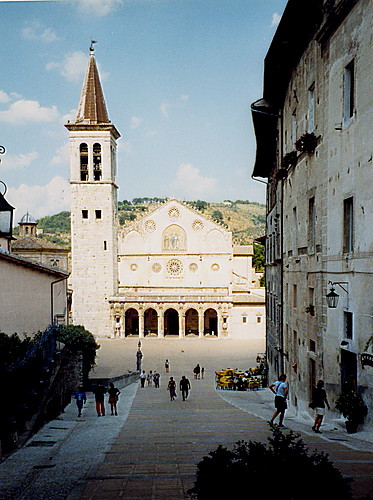
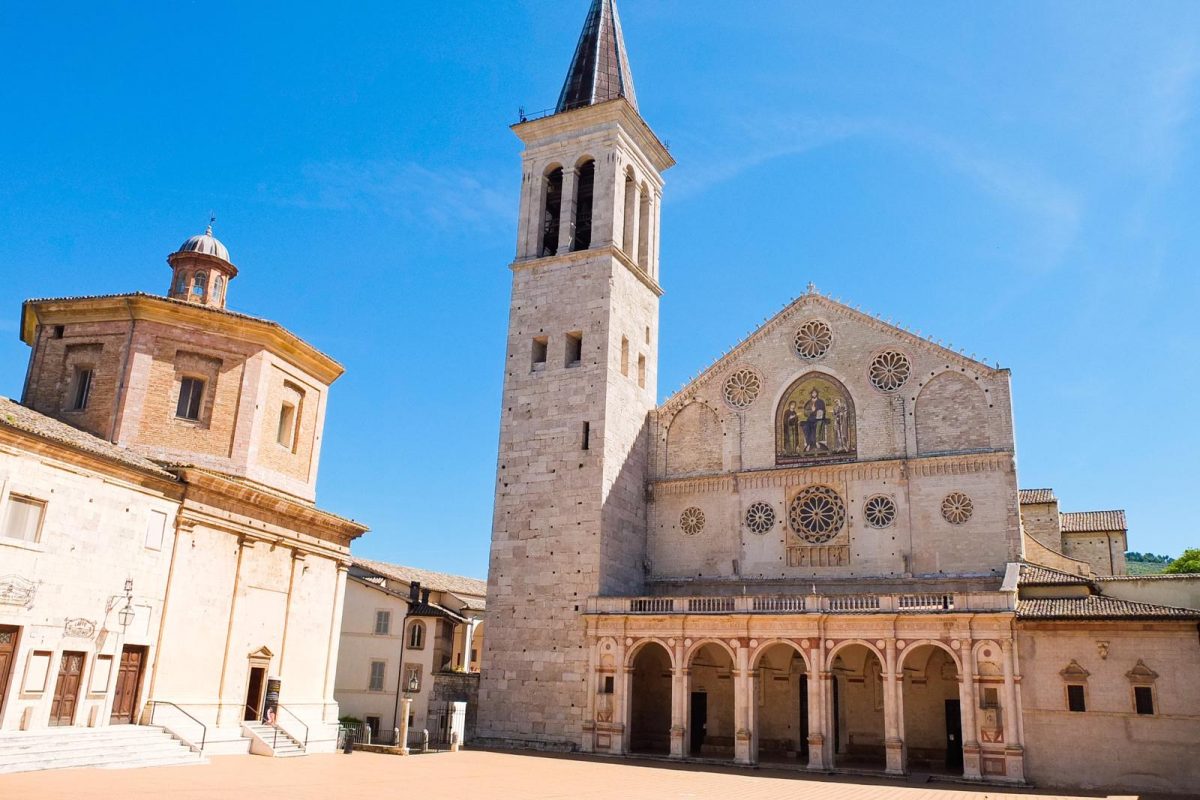
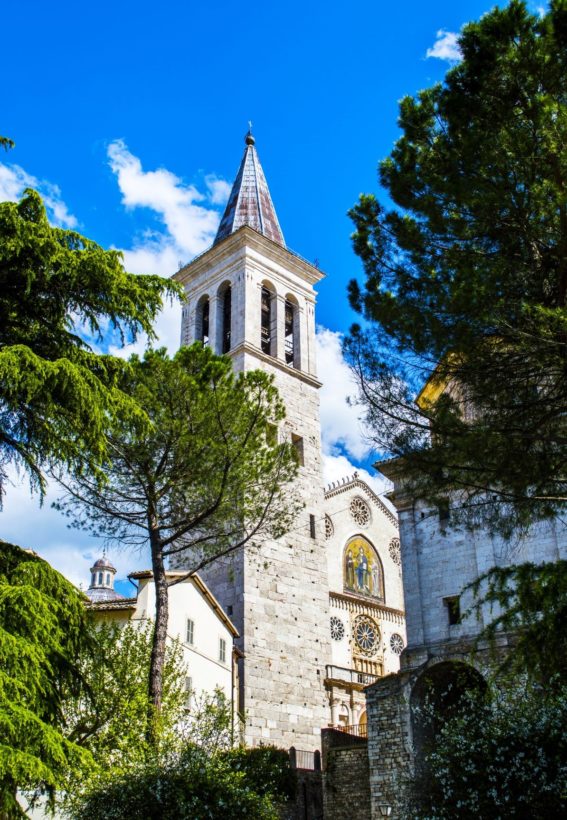
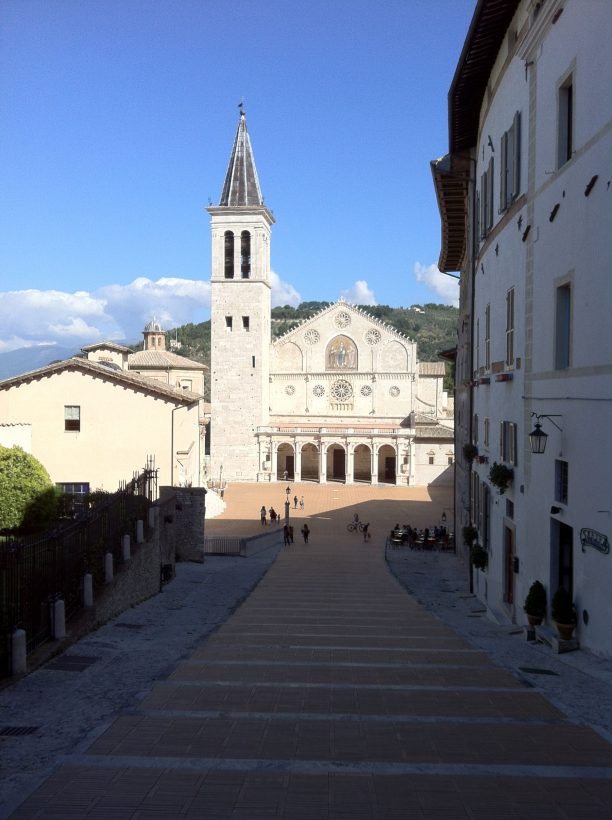
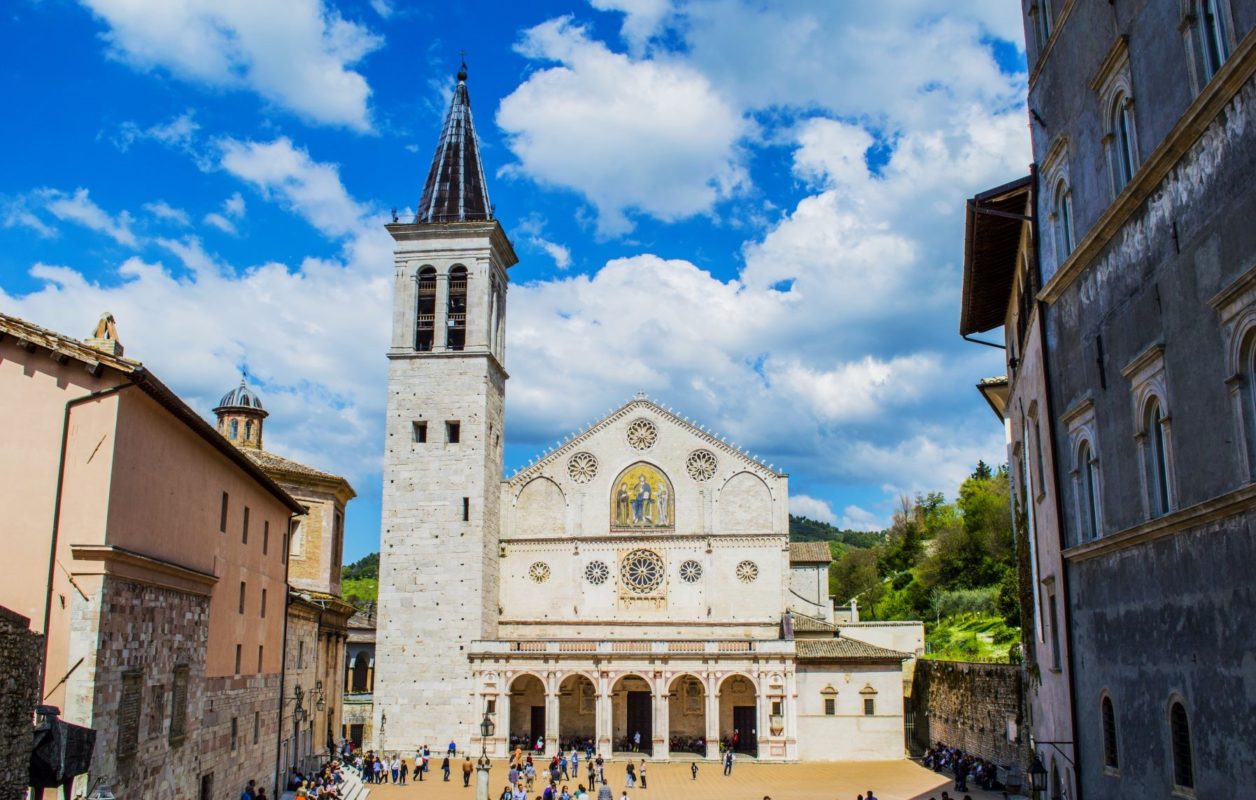
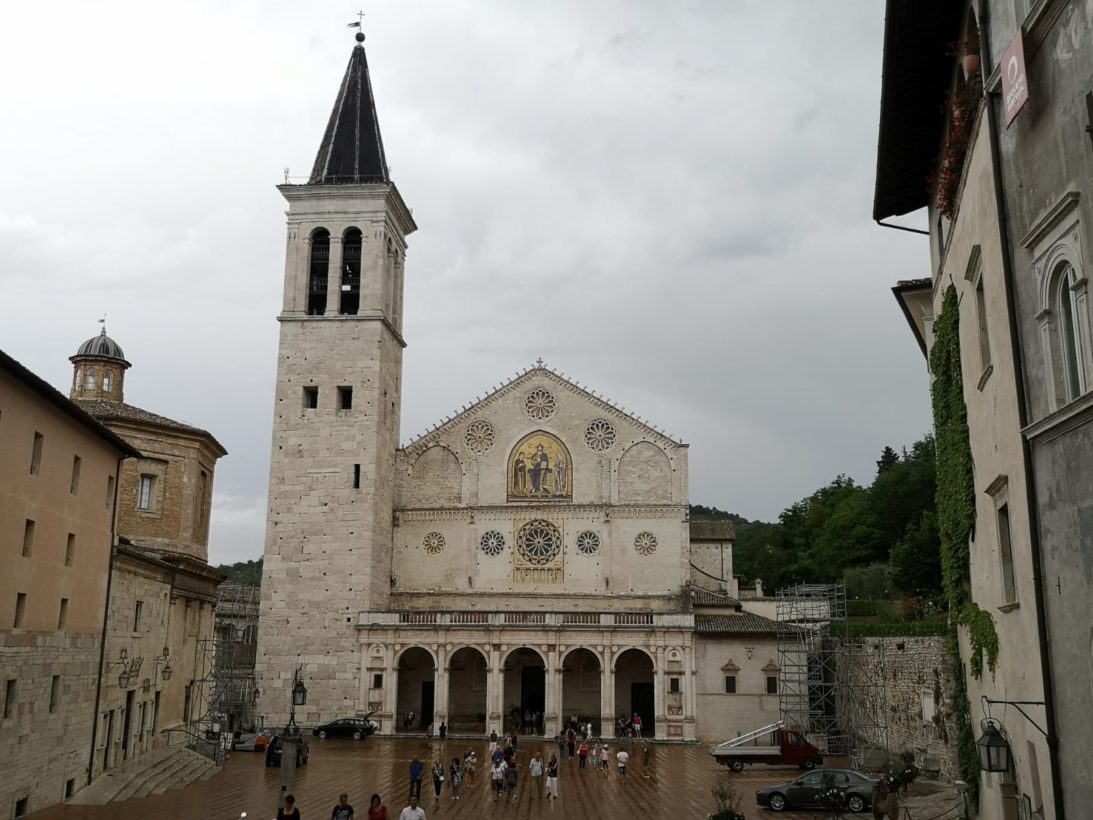
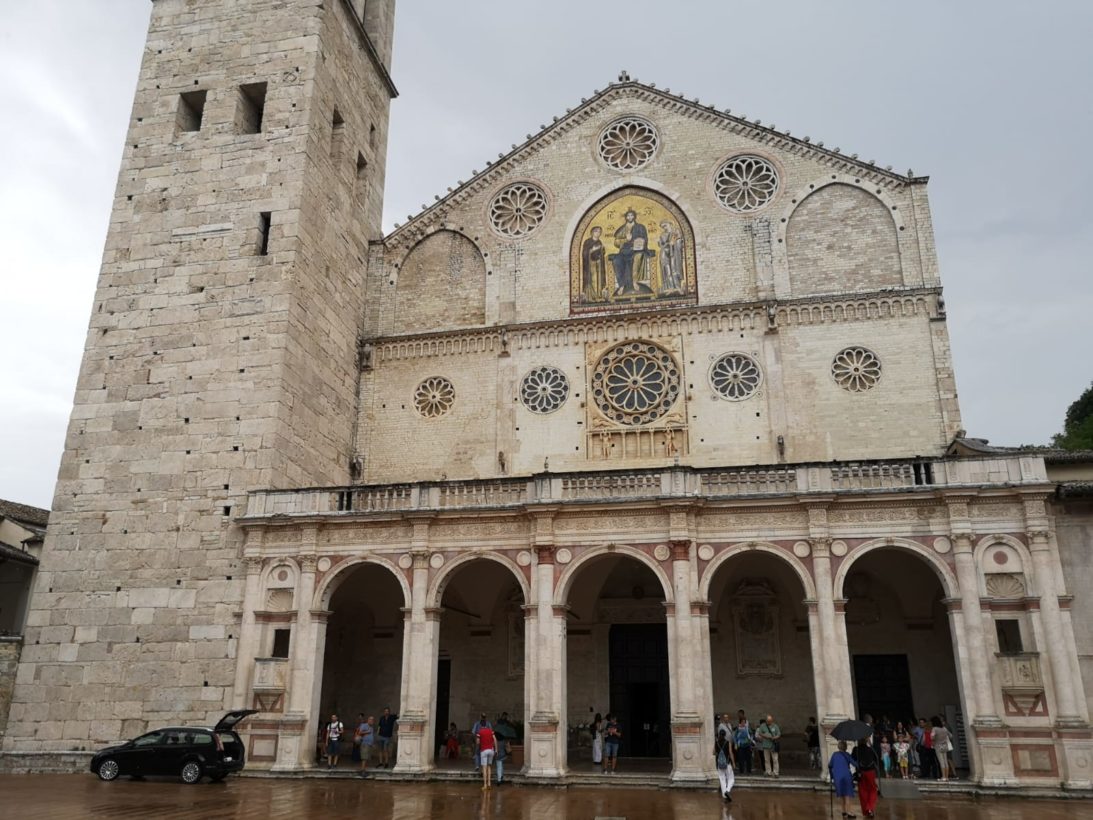
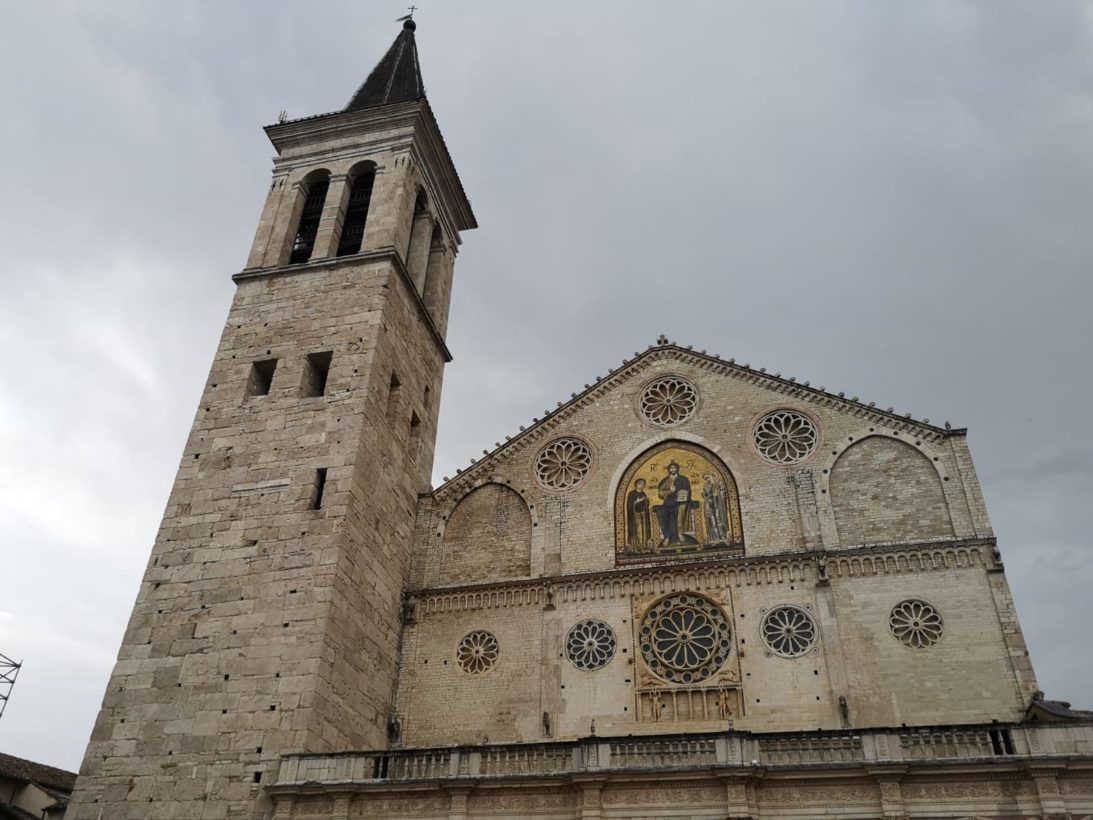
 The Cathedral in Spoleto, with its marvelous façade, constitutes a sort of backdrop in Piazza Duomo, where it stands surrounded by numerous other buildings.

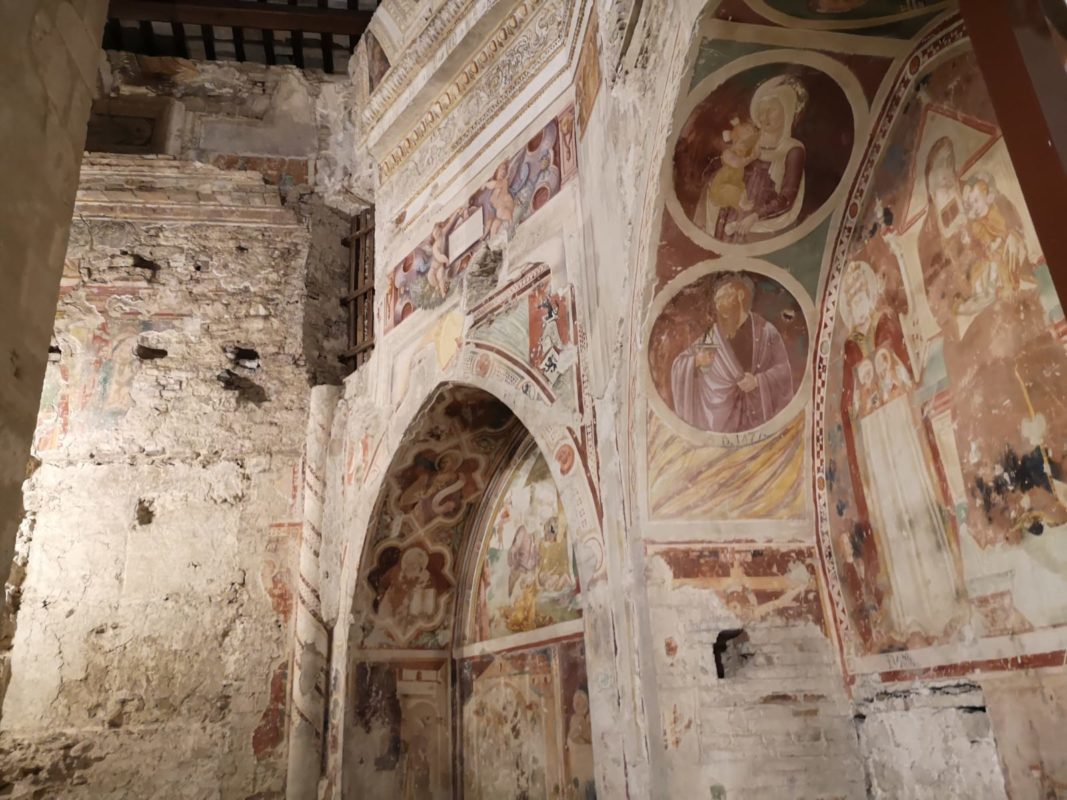
The cathedral was built in the 12th century on the remains of a previous religious building dedicated to St. Mary del Vescovado, which in turn was built on an older place of worship dedicated to the martyr Primianus. The St. Primiano Crypt, which can be accessed through the rectory, is dated to the 9th century and represents the only original portion of the ancient cathedral, rebuilt at the end of the 12th century.

The cathedral is flanked on the left by the imposing quadrangular bell tower and its façade has an elegant portico with five round arches supported by Corinthian columns, an admirable work of the master Ambrogio Barocci erected in 1492. The upper part is divided into two levels separated by a cornice supported by blind arches; the lower order is decorated with five beautiful rose windows, the larger central one is surrounded by the symbols of the four evangelists. The upper order has three rosettes and three ogival niches; the central one, of larger dimensions, is decorated by a beautiful mosaic depicting Christ enthroned between the Madonna and St. John the Evangelist. The decorative elements are further embellished by the use of blocks of pink and white local stone that enhance the architectural details.

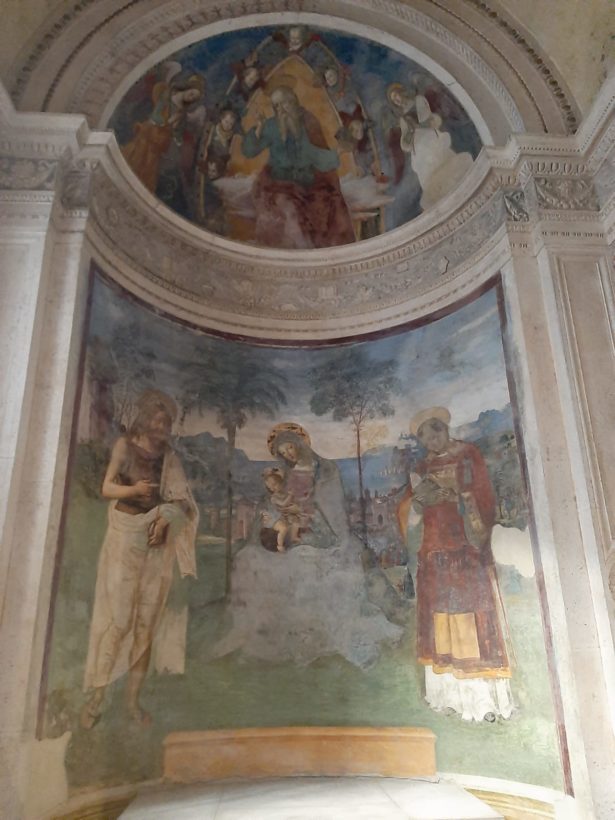
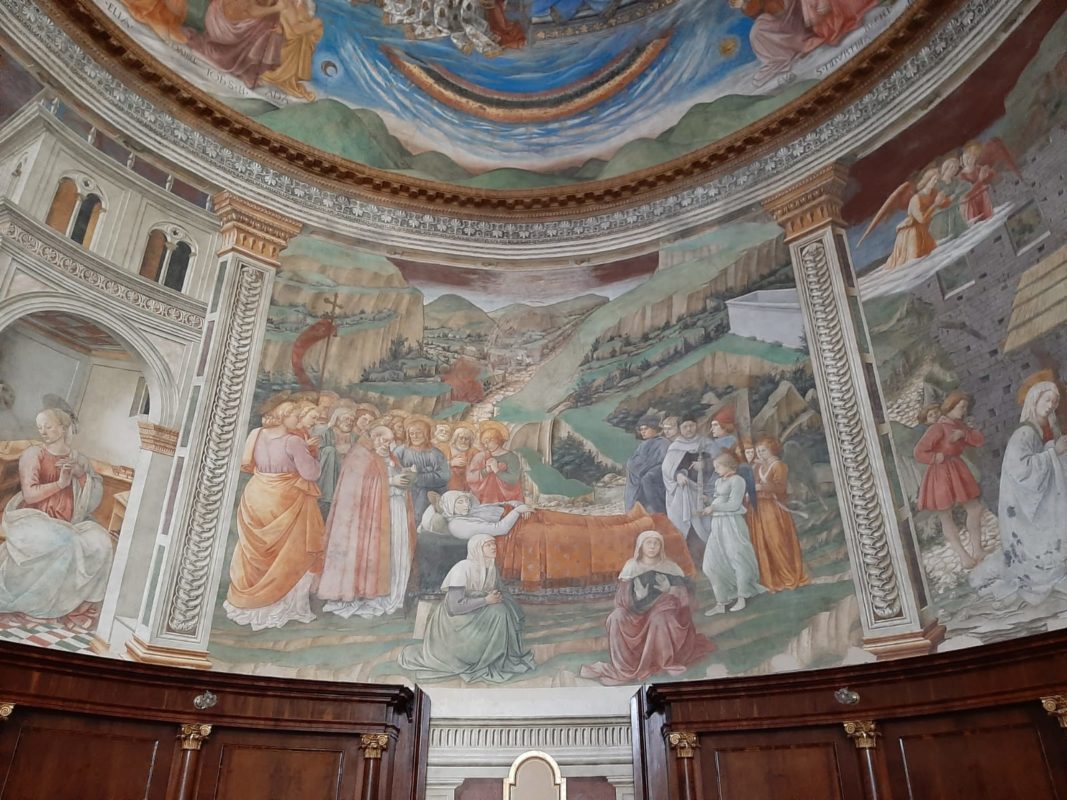
Inside the space is divided into three naves with a central apse, and the plan is a Latin cross with a transept. The church contains numerous works of art by artists from different periods:  the bronze bust of Urban VIII was done by Gian Lorenzo Bernini in 1640; the Cross painted with the icon of the living Christ (triumphans) is the work of Alberto Sotio from 1187; the series painted with stories of the Vergin, which decorates the central apse, was frescoed by Filippo Lippi between 1467 and 1469.

Finally, absolutely worthy of note are two chapels: the Chapel of the Most Holy Icon, where a 12th-century Byzantine tablet is preserved, which tradition says was donated to the city of Spoleto by Federico Barbarossa (Redbeard) as a sign of peace; and the Chapel of the Relics where one of the only two still existing letters signed by Saint Francis is kept. It is a small rectangular parchment (13 × 6 cm) made from goatskin, containing nineteen lines addressed to Fra Leone. The other signed letter is the so-called chartula, preserved in the Basilica in Assisi, which tradition says was written by Francesco in 1224, after he received the stigmatization on Mount Verna.

The inside of the building as it appears today is the result of a decisive seventeenth-century intervention that gave it a Baroque style.

Inside Spoleto’s city cemetery, and unfortunately off the beaten tourist path and nearly forgotten, stands the Basilica of San Salvatore that the renowned Spoleto historian Giuseppe Sordini called “the greatest building in Spoleto from ancient times.”

In fact, although there are no historical documents to ascertain its exact origins but different hypotheses among scholars exist regarding dates, the Basilica is clearly a building from the Early Christian period, one of the rare and most important testimonies of religious architecture of the IV and V centuries.

UNESCO confirmed its importance in 2011 when it included the Basilica and the other buildings that make up the site in the text “The Longobards in Italy. The places of power (568-774 AD)” in their list of World Heritage Sites.

Over the centuries, various interventions have changed the appearance of the Basilica and its name has been changed various times as well. Originally linked to the cemetery cult, it appears to have been dedicated to the martyr saints Concordio and Senzia, to whom miracle-working virtues were attributed. In 815, a Longobard document mentions the building as dedicated to San Salvatore, a change likely decided by the dukes of that time. Subsequently, it was known as the Monasterium Sancti Concordii, and then in the sixteenth century, based on some frescoes on the internal walls of the apse that recalled the cult of the crucifix, it was called the Church of the Crucifix.

It was only in modern times when renovations were done in the 1900s that the basilica took on the final name of Basilica of San Salvatore.

The façade has three doors but only the center one gives access to the church. The other two had been walled up long before the latest renovations. Above the doors are three windows, the center one larger than the other two.

Inside, the space is divided into three naves separated by Doric columns and pillars that define seven bays. On the walls, although quite ruined, are the remains of precious frescoes dating back to the 12th-13th centuries depicting the Eternal Father, the Madonna among the Saints, and the Crucifixion.

The church today is not open for entry but visitors can look in from the entrance door.

Connected to the Basilica is the Monumental City Cemetery, designed in 1836 by the architect Ireneo Aleandri, who designed many other important buildings in town such as the Teatro Nuovo. Entrance to the cemetery is up a large staircase with two open areas that flank it used during funerals of well-known citizens. Although these were added later to Aleandri’s design, the structure respects his neoclassical style, all of which enhance the spectacular effect of the basilica.

Among the many monumental tombs, some that particularly stand out are those of the Antonelli, Bachilli and Sansi families, which have valuable monumental sculptures and decorative paintings.

The splendid Basilica of San Gregorio Maggiore overlooks Piazza Garibaldi opposite the monument dedicated to the great hero of Italian history Giuseppe Garibaldi, a short distance from one of the entrances to the historic center of the city – Porta di San Gregorio (St Gregory’s Gate). It is just one of the various buildings dedicated to the holy martyr within the city walls; besides the basilica, there are other places of worship near the Sanguinario Bridge, also linked to the saint’s life, and in the San Gregorio forum of the Synagogue.

The basilica was built on an earlier cemetery site and was erected in its present form in 1079. It underwent numerous changes over the centuries, but according to tradition, the original church was founded in the 4th century by a widow named Abbondanza, who recovered the body of the martyr, gave it a proper burial and built the church.

The monumental facade has three 14th century arches in the upper part, surrounded by three recessed arches. The central one preserves the remains of a sixteenth-century fresco attributed to Giovanni da Foligno, perhaps also known as the artist Giovanni di Corraduccio. The entrance to the building is through a large door commissioned in 1597 by Bishop Sanvitale, framed and embellished by a sixteenth-century portico with three arches.

Inside, the basilica is divided into three naves, with a raised presbytery, in turn divided into three small aisles all ending with apses. To the sides there are various chapels, among which the most important are the Chapel of the Sacrament, where a tabernacle from 1523 is kept, which was transferred from the Star of Spoleto monastery in 1860; and the Chapel of the Innocents, decorated with scenes inspired by the history of the church and of St. Abbondanza – the saint who built the church and the martyrs that were thrown from the Sanguinario Bridge.

The crypt below the presbytery is also quite interesting; the large space is divided into five aisles with three apses. An inscription and tradition claim that as many as ten thousand martyrs were buried there. Indeed, the crypt contains numerous human remains from various periods, kept in various sarcophagi.

The building still retains fragments of the floor decorated with Cosmati stonework designs, frescoes dating from the 12th-15th centuries and numerous masonry materials from the Roman period. These are particularly visible not only in the crypt but also in the bell tower, completed in 1492. Finally, connected to the church is an elegant cloister with a double order of round arches supported by octagonal terracotta pillars. The first order was probably built in the 12th century at the same time as the church, while the second, on the upper level, was perhaps an addition from the 16th century.

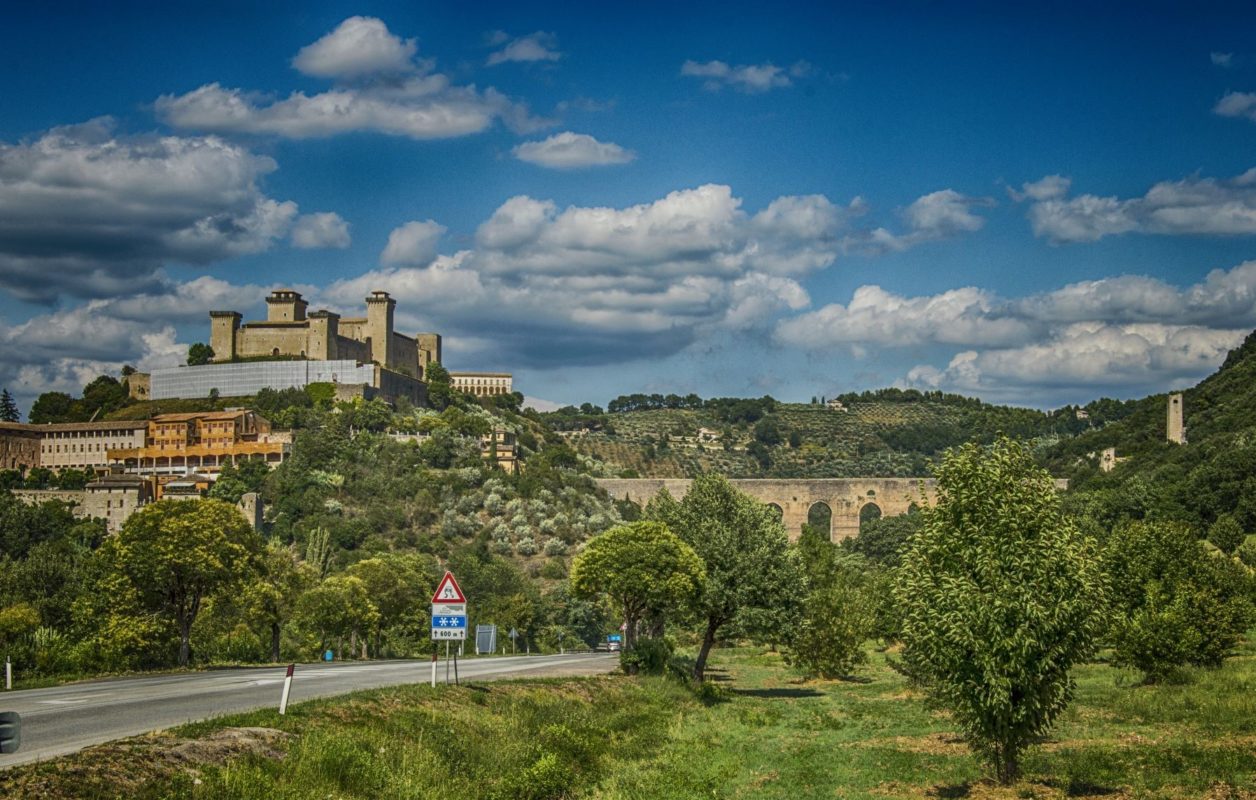
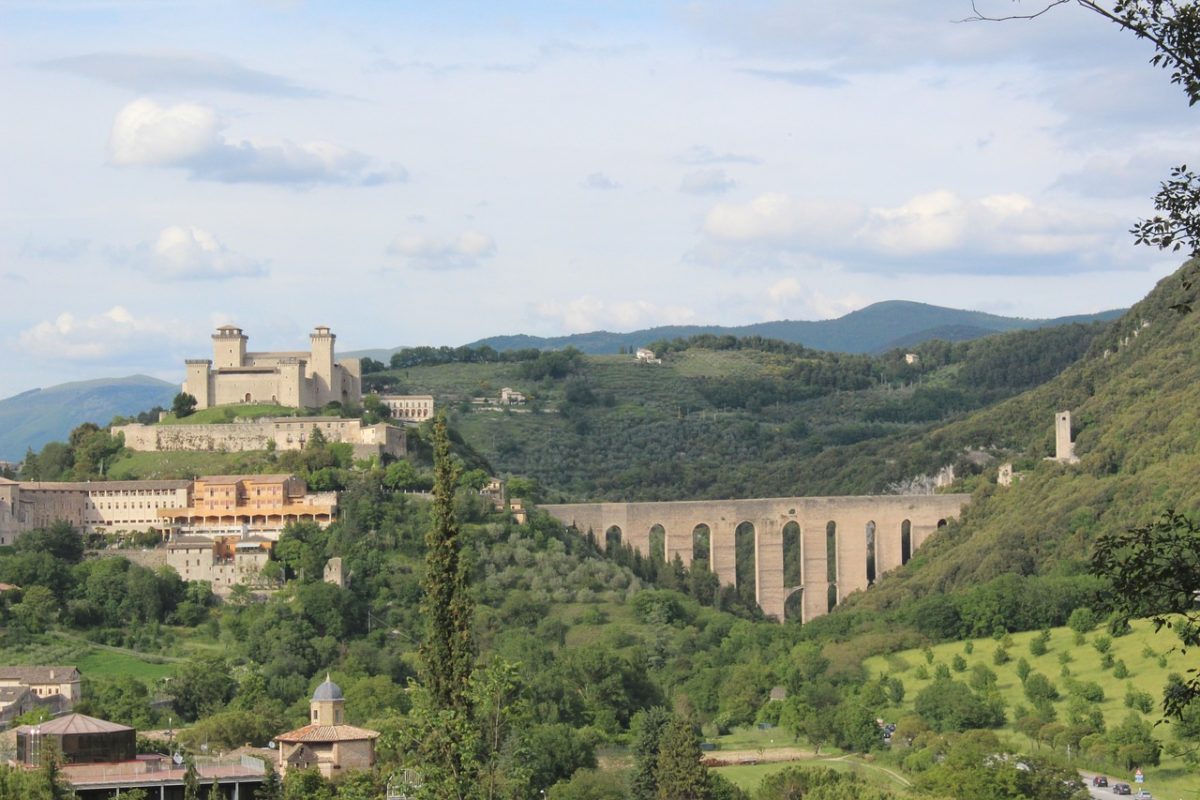
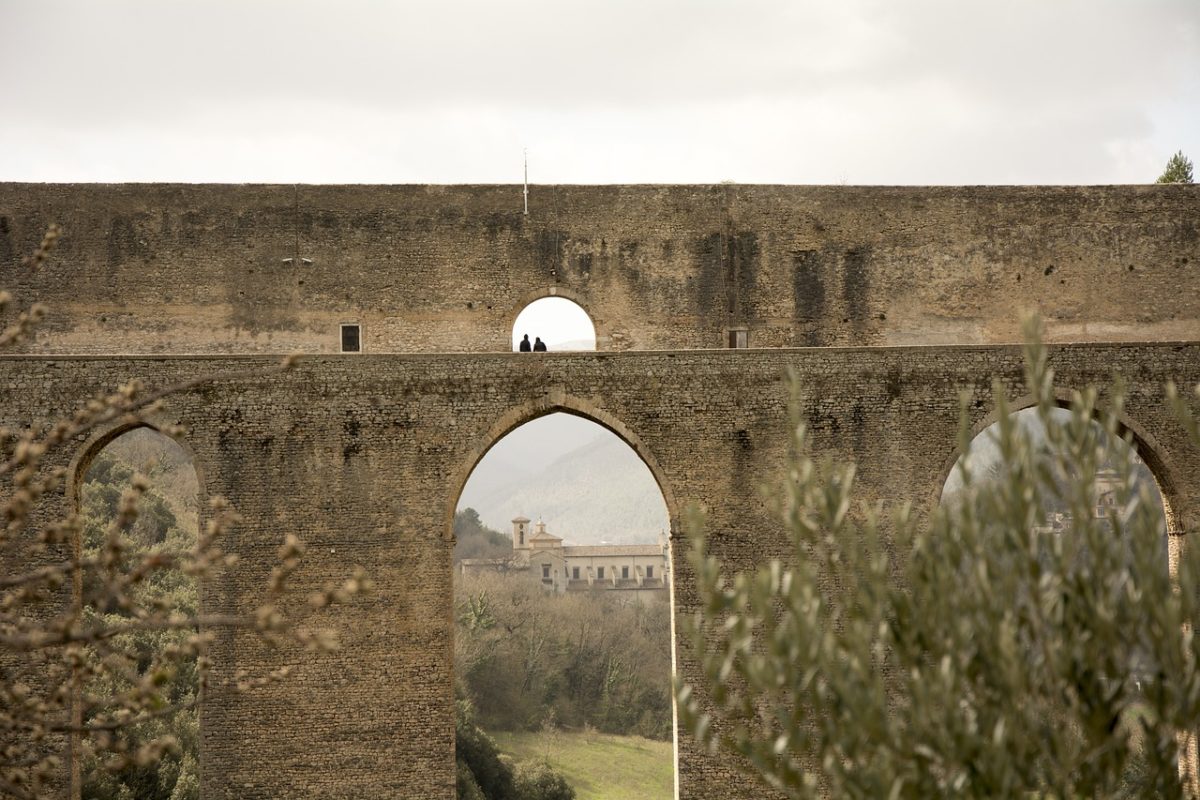
Towers Bridge, a bridge of towers, is an extraordinary structure whose bulk and beauty is a unique landmark in Spoleto. It is an imposing structure built of blocks of local limestone composed of nine enormous pillars that support ten round arches; on top is a road that connects the St Elia hill with the Rocca Albornoziana (Fortress) to the town of Spoleto and Mount Luco. The bridge serves a dual purpose – it connects the hill to the city and it is part of an aqueduct. In fact, alongside the road is a canal that carries water from the mount to the town. The date of the bridge, over 80m high (240 ft) and 236m (700 ft) long, is uncertain. Some scholars date it to the 1200s built on the ruins of an ancient Roman aqueduct; others claim it is from the 14th century when the cardinal Albornoz commissioned the fortress on the mount. It got its name most likely from two ancient towers that guarded the ends – one on mount St Elia and the other near the Fortino dei Mulini (a watermill), where there are still today two city-owned watermills that collect water from the mount and convey it to the bridge. The two center pillars have hollow bases, and there are rooms probably used long ago by guards who controlled the aqueduct and goods in transit subject to customs taxes.

The bridge has always been a favorite place from which to enjoy a breathtaking view of the town and valley, which will awe visitors and tourists just as it did the German poet Johann Wolfgang von Goethe, who dedicated an entire page to it in his book Viaggi in Italia (Travels in Italy). There is a plague commemorating this fact near the bridge itself.

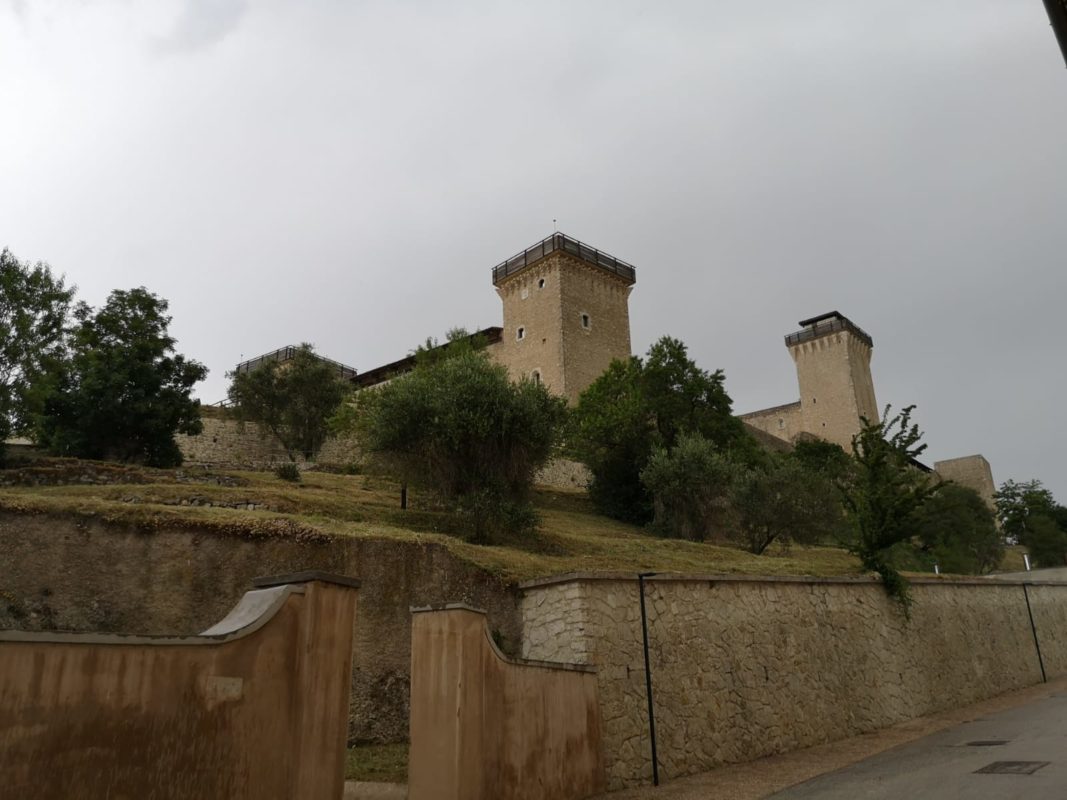
Construction of the Albornoziana Fortress, also known as the castle of Spoleto, began in 1359 at the top of the Sant’Elia hill overlooking the town and surrounding valley. This imposing military fort, built to have control over the Via Flaminia, was commissioned by Pope Alexander VI along with several others similar to it for the purpose of reinstating papal control over areas of central Italy while he was in Avignon. The pope, who lived in Avignon, sent to Spoleto a powerful Spanish cardinal named Albornoz, who asked Matteo di Giovanello da Gubbio, known as Gattopone, to oversee the construction works which were terminated in 1370.

Because of its strategic position and impressive appearance, the fortress became the seat of important authorities over the centuries such as Duchy chancellors, city governors, and papal legates. According to tradition, Lucrezia Borgia, daughter of Alexander VI, who named her ruler of the Spoleto Dukedom at just 19 years of age, stayed there on two occasions: in 1499 for three months and in 1502 during a brief stopover on her way to Ferrara.

The fortress has a rectangular plan with six imposing towers, the largest and most central of which is called “Torre della Spiritata” (Tower of the Spirited One), perhaps in reference to the outspoken pontiff’s daughter. Inside the perimeter walls there are two courtyards: the Cortile delle Armi (the Courtyard of the Armed Guards), dedicated to the armed militia and the Cortile d’Onore (Honor Yard), used by administrators and governors. This latter courtyard had a double loggia entirely in terracotta and an elegant six-sided well. Among the numerous interior rooms,  one should certainly be mentioned – the Salone d’Onore (Hall of Honor), the largest room of the entire building intended for ceremonies and banquets and decorated with frescoes from the sixteenth and seventeenth centuries, and the Camera Pinta (or Picta) (Painted Room) also decorated with frescoed scenes of chivalry from between 1392 and 1416.

Between 1817 and 1983, the fort was used as a prison and most of the artworks were lost. Only after the prison was closed did extensive renovation works begin, which restored the importance of the structure, and in 2007 the National Dukedom Museum was opened there. The museum occupies 15 old rooms of the fort on two floors. On the lower floor are chronological exhibits that tell the history of the territory known as the Dukedom of Spoleto over the period between the 4th and 15th centuries. On the upper floor are sculptures and paintings from the Romanesque and Renaissance periods.

This Roman house was discovered in 1885 by the local archeologist Giuseppe Sordini, who worked on its restoration until he died in 1914.

The house is near the old Roman Forum that is now Piazza Mercato. It was obviously the home of an important person of the times; this has been deduced from the sophisticated decorations and the architecture of the house itself. During excavations, an inscription was found dedicated to Emperor Caligola and signed by Polla. This surname can only lead one to suppose that the house belonged to Vespasiana Polla, mother of the emperor Vespasiano who was originally from the area between Norcia and Spoleto.

Despite the multiple restorations carried out over time, the type of masonry and the style of the frescoes and mosaics date this Roman house to the 1st century AD. The layout of its rooms also follows the architectural plan used in the Roman patrician houses built between the end of the republican age and the beginning of the imperial age. The rooms still have the beautiful almost intact mosaic floors. Down a short corridor you enter the central hall, the atrium, in the center of which you can admire the impluvium, a square-shaped basin in which rainwater was collected and then transferred to a 7-meter-deep cistern below. Immediately after the atrium, you enter the ablinum, the most elegant and elaborately decorated room of the house, where family, political and social activities took place. This room is flanked by two smaller rooms whose decorations probably date to a later period. Originally, the room on the left probably led to the peristiliumche, an inner garden enclosed by a portico. Around the entry hall there are two bedrooms (cubicola) and two open rooms (alae). The floor is paved with black and white mosaic tiles in geometric designs with traces of encaustic (hot wax painting) decorations.

A short distance from the city hospital in the southwest outskirts of Spoleto stands an abbey dedicated to St Paolo Inter Vineas, mentioned in several historical texts from the ancient 6th century. In one of his writings, Gregorio the Great tells of a heretical Arian bishop who went suddenly blind when he forcefully tried to celebrate a Mass in the church. There is another mention of the church in a text from the 10th century when a women’s convent was founded. The church appears today as it was restructured in 1234 and again after it underwent major works completed in 1965 to restore the ancient Romanesque architecture.

The oldest part of the abbey is the cloister with round arches on alternating columns and pillars, which was part of the nuns’ convent in the 10th century.

The external façade is very similar to those of the town’s churches of San Pietro and San Ponziano, with the main door in three recessed frames and a beautiful decorative central rose window high above. Inside, the church has three aisles that end at the transept. Most of the frescos that once decorated the walls of the whole transept and apse were removed and, unfortunately, lost during restoration work. The remaining parts of old frescos have been attributed to at least two different artists seemingly between the 12th and 13th centuries.

The small but pretty Church of Sant’Ansano stands a short distance from the Arch of Drusus and the archaeological area of ​​the town. The building as we see it today is the result of a restoration by the Milanese Antonio Dotti in the 1700s. The church has a lovely facade decorated with four large half-columns, two on each side. Entrance to the church is through a small central door surmounted by a simple rectangular window that illuminates the building. Inside, the church has a single nave and preserves valuable works of art including a beautiful fresco of the Madonna and Child and two saints painted by Giovanni di Pietro, better known as “Lo Spagna,” and a painting depicting the martyrdom of St Ansano by the seventeenth-century artist Archita Riccida Urbino.

A narrow staircase leads down to the Crypt of St. Isaac, a Syrian monk who arrived in Spoleto in the sixth century, a pioneer of hermit life on Monte Luco. The crypt is divided into three small naves separated from each other by small recycled columns with early medieval capitals dating back to the VIII-IX century, and barrel-vaulted ceilings. Numerous 11th-12th century frescos are preserved here.

Archaeological excavations have ascertained that the church must have been built in the early Christian age on a pre-existing Roman temple. Later, as the centuries passed and the road surface rose, it was necessary to build the new church above the previous one that became the crypt.

The group of structures dedicated to Sant’Agata (St Agatha) is in the street of the same name near the town’s archeological site. It is composed of a small ancient church, only the portico of which remains today and the convent commissioned in 1395 by the Benedictine nuns who lived at the Church of St Paolo Inter Vineas. When this dwelling place became unsafe, the nuns had to transfer inside the city walls, where they lived in private houses belonging to the Corvi family that one of the nuns had inherited.

Some decorative bas-reliefs are still visible on the walls of the structure, dating back to the 11th century; they show the ravens that were a symbol of the family. In the sixteenth century, the complex was enlarged and partly modified. A beautiful fresco, attributed to an anonymous Spoleto artist from that period can be seen on the back wall of the refectory depicting The Last Supper and Christ Praying in the Garden of Gethsemane. In 1886 the convent was taken over by the newly formed Italian state and the nuns, forced to abandon their headquarters, devastated the complex causing extensive damage to floors and windows before moving permanently to the monastery of Santa Lucia di Trevi, in 1965. From 1870 to 1954 the building housed a women’s prison while today it is the National Archaeological Museum. The small church annexed to the convent, which was built close to the pre-existing Roman theater, preserves only the portico consisting of three pointed arches on columns from the 11th century.

The lovely Romanesque church of St. Eufemia stands in the courtyard of the Palazzo Arcivescovile (Archbishop’s Palace). Historical texts refer to a church near the Palazzo Ducale (Duke’s Palace) dedicated to this saint in the tenth century, when Spoleto was still the capital of the powerful dukedom. According to tradition, one night in 980, Gunderada, the Mother Superior of a Benedictine monastery, with some other nuns and a priest recovered the body of the martyr Giovanni, bishop of Spoleto, and took it to the church, which later became a pilgrimage destination because of various miraculous events attributed to him. In the 11th century, the church underwent profound changes and extensions following the construction of the Archbishop’s Palace, which incorporated the previous structure, enriching it on this occasion with numerous Lombard elements. Today this church is the most valuable example of Lombard-style Romanesque architecture in the city.

In 1446, Pope Eugene IV appointed his brother Marco Condulmer as administrator of the diocese, and for some time he decided that the church would change its name and be dedicated to St Lucia. There is a column in the church decorated with a fresco of Saint Lucia, dated to 1455.

Over the following centuries, the church underwent numerous, mostly damaging renovations, until its final restoration in modern times, carried out between 1907 and 1954 by the Spoleto archaeologist Giuseppe Sordinie. Today it is used now and then for liturgical, artistic and cultural events, having been deconsecrated long ago.

The particularly simple façade is made of very light-colored stone blocks and has a large central door with recessed arches and double lancet windows.

The interior is divided into three naves separated by columns and pillars, very much reminiscent of the church of St. Lorenzo in Verona, so much so as to suggest the involvement of Veronese workers in the realization of this lovely building.

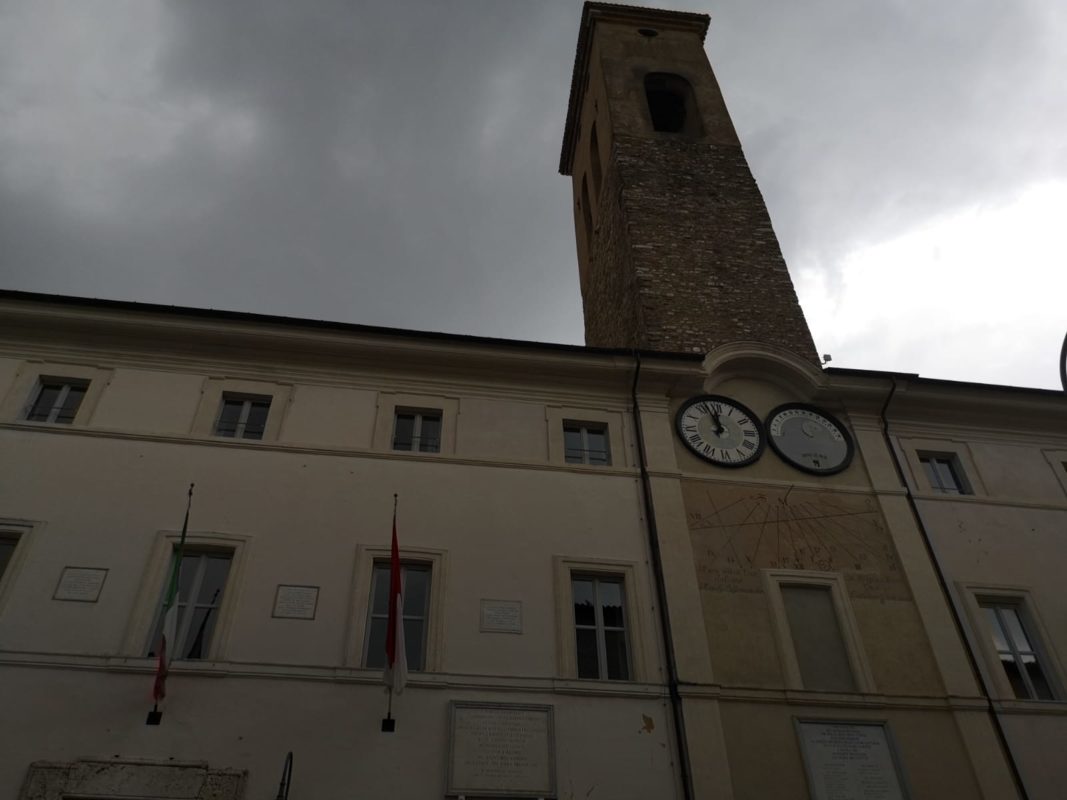
The Palazzo Comunale looks onto the square of the same name (Piazza del Comune) opposite the Bishop’s Palace (Palazzo Arcivescovile). The origins of the building date to the 13th century, but what you see today is the result of renovations and reconstruction works carried out in the 1700s; the only part remaining from the 1200s is the tall tower.

A strong earthquake seriously damaged the building in 1703. It was restored with decorations on both sides: on the north side, the decorations were done by the architect Pietro Ferrari between 1784 and 1786, whereas the southern side, the one looking onto the Piazza del Comune, was decorated by Spoleto architect Francesco Angelo Amadio, called ‘Lo Scheggino’, beginning in 1782.

In the modern age, the adjacent Palazzo Brancaleoni was incorporated into the southern facade and, from 1913, it was embellished with decorations by local artists Giuseppe Moscatelli e Benigno Peruzzi. These artists also decorated numerous rooms inside the palace with paintings and sculptures: the Dukes’ Hall (Sala dei Duchi) with portraits on the ceiling of the most important Lombard dukes of Spoleto; the Sala Caput Umbriae, in which all the most illustrious citizens of the city in history are represented; and, finally, the Chapel of San Ponziano.

The interiors of the building also house important works of art that were transferred from the former Pinacoteca Comunale, for example a large painting by Guercino and two Renaissance frescoes by “Spagna” (the painter Giovanni di Pietro). The building is now the seat of the current Municipal Art Gallery.

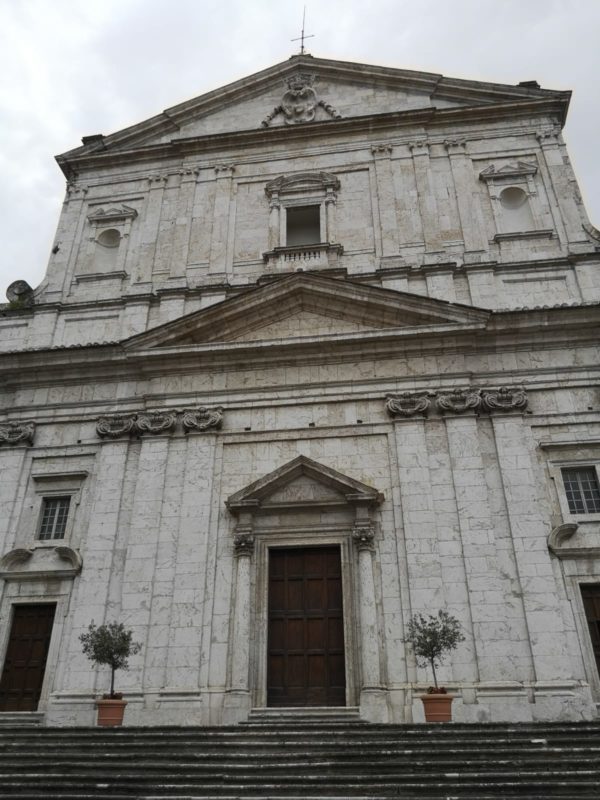
The beautiful church of San Filippo Neri (St Philip) stands in Piazza Mentana and was begun in 1640 on commission of two rich Spoletans who lived in Rome –Ugo Alberici and Loreto Vittori. Loreto Scellie was commissioned to design the building and oversee construction, which  was completed in 1671 when the dome was finished. However, the church was only consecrated in 1724. The church has the typical architectural features of Roman ecclesiastical buildings of the 1600s –  an elegant travertine marble façade embellished with pilasters and a beautiful tympanum. The interior space is divided into three naves separated by pillars and a large transept surmounted by the dome. In the sacristy is a marble bust of St. Filippo Neri by the sculptor Alessandro Algardi (1650). The side chapels have seventeenth- and eighteenth-century altars, while the walls are decorated with paintings from the eighteenth century by artists such as Gaetano Lapis, Sebastiano Conca, Pietro Labruzzi, and the Spoleto artist Francesco Refini.

The very particular Church of San Domenico in the square of the same name was built in lovely local Gothic style between the end of the 13th and the beginning of the 14th century; it is annexed to a pre-existing convent built in 1247. The church was built with blocks of pink and white stone, arranged on alternating horizontal rows, a decorative constructive style that recalls the Umbrian churches of St. Chiara in Assisi and Santa Prassede in Todi.

The church can be entered through two doors: a small one with a lunette on the main facade, and through another larger and more elegant door framed by arched cornices, which opens on the right side. The upper part of the simple façade is also decorated with a large rose window.

Inside, the church has a single nave with a large transept and houses some noteworthy artworks, including two frescoes by Giovanni Lanfrancora depicting the Triumph of St. Thomas Aquinas and the Madonna with Child and four Saints (St Ann, St Catherine of Siena, St Catherine of Alessandria and St Helen). Over the centuries, the church underwent numerous renovations, and some Baroque decorations were added between the seventeenth and eighteenth centuries; these were removed in the twentieth century during a renovation by the architect Ugo Tarchi.

This little church stands in the center of Spoleto in the area known as the Vaita Filitteria, a Byzantine quarter during the Middle Ages. It was built out of ashlar stone and reused material from the Roman era. An inscription preserved inside the church dates the foundation to 1174, although thanks to recent excavations, it has been discovered that the church we see today was built on a previous religious building, which was found in the space currently occupied by the crypt. The church is accessed through a very narrow door decorated with a lunette. The external façade, of very simple design, is decorated in the upper part by a circular rose window with a cross inside and a square frame. On the external left wall there is still a beautiful fresco of the Madonna and Four Saints, which is unfortunately in bad condition. Inside there is a single nave with a presbytery, built in the sixteenth century, raised above the crypt (which is not accessible today) and there are numerous frescoes datable to a period between the 12th and 16th centuries. On the left wall, The Martyrdom of Thomas Becket from Canterbury, dating from the 13th century, is particularly noteworthy. This extraordinary work constitutes one of the very rare representations of the murder of the English bishop, recalling his controversy with the Chancellor of the Kingdom of England, Henry II. The event could also be interpreted in reference to the history of the city, connecting it to the struggle between empire and the papacy for sovereignty over the Duchy of Spoleto. On the right wall there is another valuable fresco representing Herod’s Banquet and the Dance of Salome. Another masterpiece depicting the Martyrdom of Saints John and Paul was detached from a wall of the crypt in 1961 and is now preserved in the National Museum of the Duchy at the Villa Albornoziana. The most recent frescoes are attributed to the local prelate and artist Pier Matteo Piergili, who worked in the small church in the sixteenth century.

The very particular Church of St. Maria della Manna d’Oro is located in the heart of the city of Spoleto in the lovely Piazza Duomo adjacent to the Caio Melisso Theater. The church was built by the municipality in 1527 as a sign of gratitude to the Virgin after the attack on Rome by the Lanzichenecchi invaders. In fact, thanks to the protection of the Virgin, the city was not only spared from the fury of the troops of Charles V but it was even enriched enormously thanks to trade with the invading soldiers. This wealth was compared to the manna from heaven that the Israelites received in the desert as related in the Bible. The church has a rectangular shape outside, with an octagonal drum in the upper part. Inside, the space has an octagonal layout with an apsidal presbytery, a form that was given to it after interventions in 1679.  In the center of the church there is a very valuable fifteenth-century baptismal font, which came from the Eroli Chapel of the nearby cathedral (Duomo). This church is no longer consecrated; it is used as an exhibition center.

Today, the amphitheater still has a semi-circular seating section 70 meters in diameter, partially built on a semi-circular portico with vaulted ceilings, from where the spectators could enter the seating section through three different openings. The colorful marble flooring of the orchestra ‘pit’ is still visible; but where the stage was, one can only see holes in the floor that held the poles for the stage curtain.

Built outside of the city walls in the 2nd century AD, the entire structure was made from stone chippings mixed with lime covered in opus vittata with regularly cut blocks of grey limestone arranged in horizontal rows. The theater must have had two tiers of overlapping arches. Today you can see on both levels large sections of the external corridors.

Thanks to studies on the techniques used, the construction has been identified as a single project. In 545 AD, Totila, king of the Ostrogoths, transformed the theater into a fortress and for over a century it was used for military purposes. At the beginning of the 12th century in the amphitheater area, on about 51,000 square feet, a church was built dedicated to St Gregorio Minor, assuming that this was the place where the martyr was killed.

During the Middle Ages the theater became a market place and shops were set up in the niches under the arches.

Later, the area became a sort of quarry: the stone material was used to build the Rocca Albornoziana fortress, and later for buildings in town.

Today, most of the amphitheater, from the external corridors to the lower entrances to the seating area, have been incorporated in the city limits and is now a part of a single structure belonging to the Severo Minevio military barracks.

The structure houses Spoleto’s archeological museum, and concerts and cultural events are still held here, mainly during the well known Festival dei Due Mondi.

The San Niccolò complex, which includes the church and adjacent convent, is in the center of the historical town center near Via Elladio. Construction began in 1304 by the Augustinian monks on a site where private homes and two other churches previously stood – a primitive church from the 4th century dedicated to San Niccolò of Bari and one dedicated to San Massimo.  The new complex was built in monumental forms – the large church having a single nave, characterized architecturally by vertical development. The convent housed a lavish, well-stocked library of humanistic texts which became a very important place frequented by the greatest scholars of the time, among whom Martin Luther, who stayed there in 1512.

The façade of the church is very simple, with a double slanted roof and a single entrance door in Gothic style, decorated with a frescoed lunette representing the Madonna between Saints Agostino and Nicola, dated to 1412 and attributed to a painter conventionally called “Maestro della Dormitio of Terni. ”

The convent is beautified by two cloisters: one from the 1300s built out of pink and white stone with round arches on pillars, and the other from later in the 15th century, which has two orders of smaller terracotta columns. The arcades of the cloister enclose a large courtyard with two stone sculptures by Anna Mahler: A Woman Drinking and Woman Observing the Sun. A strong earthquake destroyed the complex in 1767 and it fell into disuse. For years it was used as a storage area and improvised shelter until it was renovated in modern times during the 1960s. The building is now used as a congress center, for exhibitions and cultural events of various kinds.

Spoleto, like most Umbrian cities, has preserved almost intact its anti-structured profile with an interesting, ancient boundary wall still visible in various parts of the city. Studies of the remains of walls by archaeologists have made it possible to recognize different building techniques datable to a period of construction between the IV and I centuries BC. The Romans were interested in this settlement and its defense especially after Spoleto became a colonia in 241 AD and later a municipium. The entire wall was two km long, along which building techniques have been identified such as the polygonal shape and the square shape, built from long rectangular blocks of stone.  You can still see pieces of the ancient wall in via dei Cecili, where a large part of the San Nicolò convent is still supported by Roman terracing; in the Piperno garden, where a Latin inscription mentions the magistrates who were responsible for restorations in the 1st century BC; and, finally, the two remaining arches at the famous Sanguinario Bridge near Piazza Garibaldi.


In the northwestern area of ​​the city, not far from the Porta Fuga gate and incorporated into the sixteenth-century Palazzo Vigili, stands the tallest and best preserved tower in Spoleto: Torre dell’Olio. Despite the fact that its architectural characteristics date it to the 13th century, the tower is remembered by legend and tradition as that insurmountable fundamental bastion that stopped the advance of Hannibal, the Carthaginian general, who in 217 BC routed the Romans near Lake Trasimeno and menacingly approached Rome. It appears very unlikely that the tower already existed at the time of Hannibal and the Romans, so it is plausible that the story handed down through generations refers to a previous defensive bulwark. In fact, the tower is so-called because the soldiers threw boiling oil on the enemies from its walls. The effectiveness of the defensive action is evidenced by the name given to the nearby gate (Porta), called precisely “Escape” (Fuga). The Oil Tower measures about three meters by seven (12 by 21 ft), and rises to more than forty-five meters (135 ft), twenty more compared to the building to which it belongs.

Sanguinario Bridge is in the center of Spoleto below Piazza Vittorio and near the Roman amphitheater. Built in Roman times, supposedly in the 1st century BC, the bridge is formed by three deep circular arches built of square blocks of travertine marble, a very solid stone with great resistance to wear over time. It was built during the reign of the emperor Augustus to cross the Tessino River along the Flaminian Road; however, over the centuries the riverbed shifted to the north so that at a certain point it had no function and later flooding filled and buried it.

It was discovered in 1817 during restoration works commissioned by the Papal State, and the works were hastily concluded in 1820 in time for a visit to Spoleto by the Austrian Emperor Franz II.

There are various legends surrounding the name of the bridge. Some claim that religious martyrs were beheaded there and their heads thrown in the river. Another legend claims that the bodies of men who died fighting in the amphitheater were thrown from the bridge. It is also said that in 253 BC, the Roman emperor Romano Emiliano was killed nearby by his own soldiers after reigning for only three months.

The version that most scholars accredit to truth regarding the bridge’s name is that concerning the martyr San Ponziano, patron saint of Spoleto. In the 2nd century BC, under the reign of the Roman emperor Marcus Aurelius, there lived in Spoleto a young noble man called Ponziano who claimed God came to him in a dream and asked him to become His servant. With no second thoughts, he converted and began preaching about Christianity. Marcus Aurelius’ anti-Christ policies were unwavering, and when his soldiers arrived in Spoleto Ponziano was persecuted, first by being thrown to the lions in the amphitheater, but they didn’t go near him; then by being thrown onto hot coals but they didn’t burn him, and finally by being beheaded on the bridge. When his head fell to the ground, it began spewing pure water; and it is on that spot that the church dedicated to him was built.

In more recent times, it has been said that the bridge’s name is a distortion of the word “sandapilarius,” the name of one of the doors to the Roman amphitheater or that it comes from the name of the Sanguineto creek that runs into the Tessino River.

There is a short ramp of stairs that visitors can take to see the bridge, but only two of the arches are visible due to ongoing excavation works.

After a visit to the bridge and to other beautiful sites in Spoleto, you can get an idea of how many legends still surround the town’s history perhaps by stopping at some of the cafes and restaurants to sample typical foods and wine.

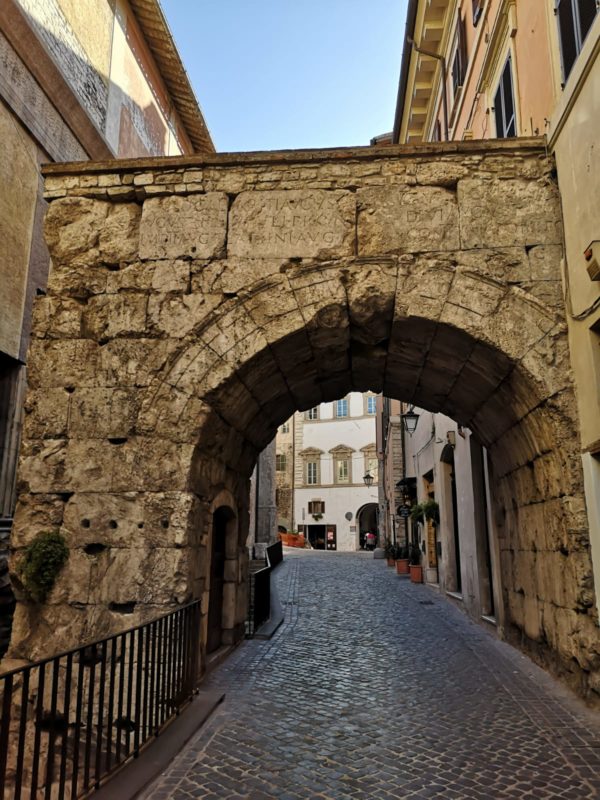
The arch stands near the Piazza del Mercato (Market Square), which was once the Forum. Based on inscriptions still visible on the arch, it dates back to 23 AD and was built by decree of the Senate in honor of Drusus, son of the emperor Tiberius, and of Germanicus, cousin of Drusus but who became his brother after being adopted by Tiberius. It is formed by a single arch made from large square blocks of stone carved on the front to form a decorative frame; only fragments of it survive today. During the Middle Ages it was incorporated by neighboring buildings and, only thanks to renovations in the 1950s, today it is possible to admire the eastern part of the structure visible down to the ancient base.

At the foot of Monte Luco, near the southern entrance to the city, there is what is considered by many to be one of the most beautiful Romanesque churches in the whole of Umbria. The Church of San Pietro Extra Moenia was erected at the request of the Spoletan Bishop Achilleo, in a cemetery area already used in the 7th century for the burial of bishops (in fact many tombstones are preserved inside the building). The church underwent numerous renovations over the centuries but its current appearance is due to the works carried out between the 12th and 13th centuries, the period when the precious decorative designs of the façade were done. The alternation of horizontal cornices and vertical pilasters creates a series of panels decorated with bas-reliefs of the most diverse subjects that give the façade a unique look, of Romanesque style but with Renaissance elegance. The church is accessed up a wide seventeenth-century staircase that leads to the three doors, the central one flanked by lions, the two lateral ones by rams. There are bas-reliefs on the architrave of the central door and all around it showing the Tree of Life and other symbolic elements such as a deer devouring a snake, the peacock, symbol of resurrection, and scenes of men at work. On either side of the main door there are rectangular panels containing scenes relating to the life of St. Peter. In the upper left panel, one can see the following scenes: the washing of the feet and the summoning of Peter and Andrew by Christ; the other panels show symbolic scenes related to the Christian religion and medieval fables: the death of the righteous, the death of the sinner, the lion and the woodcutter, the fake dead fox, some crows, the student wolf and the ram, the lion and the dragon. Every figure has a symbolic meaning related to religious teachings in the Middle Ages: repentance at the moment of death that saves sinners from eternal damnation, the fox as a symbol of Satan who pretends to be something he is not to attract the souls of men represented by crows, and so on. Above the side doors with architraves and decorated with a round arch, there are two panels depicting Saint Michael the Archangel killing the dragon and a bishop saint. The upper part has three rose windows, the central one with a Cosmati frame and symbols of the four evangelists. Finally, in the central tympanum, a rectangular panel was created which was perhaps supposed to house a decorative mosaic that was never made. Inside, the building is divided into three aisles with aspes, separated by pillars that support round arches leading to lateral chapels with elaborate altars. The beautiful elliptical dome above the interior is one of a kind in Umbria. Inside there are works of art by different artists from the 12th to the 17th centuries.


The Sanctuary of the Madonna of Loreto is located at the end of the street of the same name – via Loreto – near the Porta di San Matteo gate, also known as the ‘Loreto Gate’. On this site in 1537, the young Spoletan Jacopo Spinelli erected a Maestà (Majesty) inside a beautiful reproduction of Mary’s house in Nazareth. The actual decorative painting, a fresco depicting the Madonna and saints Sebatian and Anthony, was entrusted to the artist Jacopo Santoro da Giuliana, known as Jacopo Siculo. Tradition holds that the painting was not completed by the artists but by divine intervention and therefore it immediately became the object of adoration by the people. During an earthquake in Spoleto in 1571, the people prayed to the Madonna to stop the tremors. Locals claimed that many of the faithful standing in front of the painting on that occasion saw the Madonna look down onto those present.  It was then decided to build an imposing structure to preserve and protect the sacred image and make the road leading to it more important by building the large gate. The building of the modern church began in 1572 based on a design by Annibale dè Lippidi Firenze. The church has a simple but elegant façade, with two orders separated by a projecting cornice, and is decorated with pilasters surmounted by a smooth frieze. The upper part is embellished by a large tympanum and a round arch that frames the central window. The elaborate entrance door was added later in 1662. The large interior, in the form of a Greek cross, is elegantly furnished in a refined Renaissance style. Various works of art are preserved there, including paintings and sculptures from the 17th century, and in the center stands Spinelli’s beautiful Majesty.

Outside the historic center on the northern outskirts of Spoleto, there is a beautiful villa with an immense garden that today has become a public park, a magnificent green area open to locals and tourists. In the 16th century in the place where a Roman quarter once stood, an elegant mansion was built commissioned by the noble Martorelli family of Spoleto. Over the centuries, as the house changed owners, it underwent various restructuring projects. The Locatelli family bought it in the 1700s and wanted to give it an appearance of grandeur worthy of the popes Pious VI and Pious VII who lived in it. In 1823 it passed through the hands of Francesco Marignoli, who owned it briefly, selling it soon to Annibale Sermatti della Genga, also a member of the nobles of Spoleto and who became pope in 1823 under the name Leon XII.  Several decades later, in 1885, the Marignolis bought it again, when it became known as the Villa Redenta, or ‘Rebought Villa.’ The villa is a large square building between two angular towers. The house has a monumental entrance with three arches on the side facing the garden; another entrance on via Flaminia has a large door with an overlooking balcony with wrought iron railings. Inside the villa there are 15th century frescoes, a beautiful mosaic floor from Roman times and lovely decorations from the 17th-19th centuries, among which some life-sized Napoleonic soldiers. Particularly intriguing are the exotic landscapes in the Sala Cinese (Chinese Room) and the mythological scenes in the Sala Canoviana (Canoviana Room). The villa also has a chapel, a café house in Rococò style, a guesthouse (hostel) and stables. The gardens are absolutely worth visiting: there are 900 different species of plants, among which a Lebanon Cypress 19m high (60 ft).  The garden is enhanced with a small outdoor theater and artificial Roman ruins that give charm to the entire area.

Oltre ad una storia millenaria e affascinanti monumenti, a Spoleto avrete la possibilità di scoprire una natura selvaggia. Fatta di secolari boschi e corsi d’acqua cristallina è, in altre parole, l’ambiente ideale per ogni tipo di escursione o per una semplice passeggiata all’aria aperta.

Pedalando su una bicicletta, a piedi o in sella ad un cavallo, sono numerosissimi i sentieri da percorrere. Immergetevi tra i lecci sempreverdi del “Bosco sacro” che ricopre il Monteluco. Scoprite i numerosi eremi e le grotte di cui è disseminato. Raggiungete il Santuario di Monteluco fondato, secondo la tradizione, da San Francesco in persona. Oppure pedalate lungo la Spoleto-Norcia. Una tratta ferroviaria dismessa che oggi è divenuta una splendida pista ciclabile. È lunga 51 chilometri, ed è caratterizzata da suggestive gallerie e alti viadotti da cui godere di panorami da favola. Spoleto, inoltre, è anche una tappa del “Cammino di San Francesco”, l’itinerario che ripercorre i luoghi della vita del Poverello di Assisi.

Restando in città potrete optare per un tour con le nostre guide professionali tra monumenti, chiese e musei. In aggiunta a questo potreste cimentarvi in una insolita caccia al tesoro, che si trasforma in una caccia alle “sculture”. L’edizione del Festival dei Due Mondi del 1962, infatti, aveva ospitato su proposta di Giovanni Carandente una vera e propria Mostra di sculture in città. Alla quale avevano partecipato ben cinquantatré scultori, tra i più noti del tempo. Realizzarono 104 sculture disseminandole tra le vie e le piazze cittadine. Buona parte di quelle opere d’arte sono oggi conservate al National Gallery di Washington. Con un po’ di pazienza, però, potrete avere il privilegio di ammirare alcuni di quei capolavori che ancora abbelliscono le strade spoletine.

Questo l’elenco delle sculture che potrete trovare in città: Teodelapio di Alexander Calder (Piazzale Polvani), Stranger III di Lynn Chadwick (Piazza del Duomo), Colloquio Spoletino di Pietro Consagra (Via Salara Vecchia/Via Filitteria), Spoleto 1962 di Nino Franchina (Piazza del Comune), Il dono di Icaro di Beverly Pepper (Piazzale Roma), Colonna del Viaggiatore di Arnaldo Pomodoro (Viale Trento e Trieste).

Nella parte nord della città si trova il Parco Pubblico di Villa Redenta. Una lussuosa dimora costruita su un antico quartiere romano. Oggi è uno spazio verde fruibile a tutti e ideale per una tranquilla passeggiata. A poca distanza troverete uno dei complessi monumentali più famosi di Spoleto. Nonché patrimonio mondiale dell’UNESCO dal 2011, la Basilica di San Salvatore e il Monumentale Cimitero Civico. All’interno del quale, se non siete troppo superstiziosi o paurosi, sarà possibile ammirare delle ricche sepolture.

Dulcis in Fundo, potrete godervi un meraviglioso connubio tra natura e architettura. In grado di disegnare un panorama che non mancò di incantare un personaggio del calibro di Wolfgang Von Goethe quando, nel Settecento, visitò la città. Davanti alla vostra vista si aprirà l’indescrivibile scenario del Ponte delle Torri. Un’opera monumentale composta da dieci arcate che collegano il colle S. Elia con il Monte Luco e, immediatamente al di sopra, la maestosa fortezza della Rocca Albornoziana. Dalla cima del Colle S. Elia dominava e difendeva la città. La struttura oggi ospita il Museo Nazionale del Ducato di Spoleto.

do you want to know more?

La storia di Spoleto dalle origini al medioevo: il Ducato di Spoleto.

Per la felice posizione che occupa, sulla cima del colle S. Elia e ai piedi del Monte Luco che la proteggeva, l’area di Spoleto fu abitata fin dai tempi molto antichi. Resti di alcune abitazioni e parti di costruzioni megalitiche che formavano una primitiva cinta muraria, meglio note come Mura Ciclopiche, risalgono all’Età del Bronzo quando la zona era occupata dalla popolazione degli Umbri.

Spoleto interessò ben presto i Romani che cominciarono ad estendere il proprio dominio sulla città fin dal 241 a.C. facendone una colonia. Pochi decenni dopo, con la costruzione della Via Flaminia che attraversava la città da parte a parte (si entrava per Porta Monterone a sud e si usciva da Porta Fuga a nord), l’importanza della città crebbe ulteriormente. In occasione della seconda guerra punica gli Spoletini si distinsero per il valore con cui fermarono l’avanzata di Annibale verso Roma tanto da ottenere, nel 90 a.C., il prestigioso titolo di municipium. Per tutto il periodo dell’Impero, Spoletium dovette godere di grande fama e di ingenti ricchezze testimoniate dai numerosi resti romani ancora ben conservati in città. E questa condizione di privilegio e di forte egemonia non dovette venire meno nemmeno con la caduta dei romani e l’arrivo dei barbari.

I primi ad occupare Spoleto furono i Goti di Teodorico il Grande, che la presero nel 493. Pochi decenni più tardi, l’imperatore bizantino Giustiniano, nel tentativo di recuperare i territori già appartenuti all’Impero Romano d’Occidente, inviò in Italia il generale Belisario. Riuscì a strappare la città ai Goti nel 537 ma la perdette nuovamente nel 545. Sconfitti i Bizantini, il re Totila stabilì il proprio quartier generale proprio a Spoleto e riuscì a mantenerne il controllo fino al 552 quando venne definitivamente sconfitto da un altro generale bizantino, Narsete.

Già del IV secolo, Spoleto divenne sede episcopale sviluppando una forte gerarchia ecclesiastica dovuta alla posizione al confine con lo Stato Pontificio, che ne costituirà sempre un grandissimo punto di forza.

In seguito all’arrivo dei Longobardi in Italia Faroaldo istituì il Ducato di Spoleto che assieme a quello di Benevento costituiva la Longobardia Minor. Un territorio molto vasto, che arrivava fino alla Calabria, e di cui i Longobardi avevano pieno controllo. Sebbene sotto la giurisdizione longobarda, Spoleto ed i suoi duchi poterono conservare una certa autonomia proprio grazie alla vicinanza dello Stato Pontificio. La situazione si modificò in parte solo a partire dal 729, quando la città passò sotto il controllo del re Liutprando.

Il Ducato di Spoleto cadde nel 774, quando i Longobardi vennero duramente sconfitti dai Franchi, alleati del Papa, ed i territori del Ducato vennero inglobati nell’Impero Carolingio prima e nel Sacro Romano Impero poi.

La storia di Spoleto durante l’età comunale e il Rinascimento.

Nonostante l’annessione al Sacro Romano Impero, il dominio di Franchi e Carolingi non fu particolarmente gravoso per Spoleto che continuò a godere di potere ed autonomia fino al duro attacco di Federico Barbarossa, il quale, sceso in Italia per essere incoronato Imperatore dal Papa nel 1155, incendiò la città distruggendone buona parte.

Per diverso tempo il controllo della città e del suo territorio fu oggetto di disputa e scontri tra Impero e Papato, fino alla definitiva annessione di Spoleto allo Stato Pontificio, nel 1198.

In questo stesso periodo la città si era autonomamente costituita sotto forma di libero Comune. La nascita degli ordini mendicanti (Benedettini, Francescani, Domenicani, Agostiniani) e la loro diffusione presso il Monte Luco, contribuì alla crescita esponenziale degli edifici religiosi del centro storico e all’abbellimento ed arricchimento architettonico della città. L’intervento del Cardinale Albornoz nel XIV secolo, con la costruzione della Rocca, conferì ulteriore importanza a Spoleto che divenne uno degli avamposti del papa durante il periodo della cattività avignonese e contribuì a richiamare artisti e visitatori da tutta Europa, quali Filippo Lippi e Antonio da Sangallo il Giovane, che resero la città un florido centro culturale fino al Seicento.

La storia di Spoleto durante l’età moderna.

Tra alterne vicende e pur conservando sempre la propria storia di autonomia ed indipendenza, Spoleto rimase ancora formalmente sotto il controllo pontificio fino alla breve parentesi del Regno napoleonico. Infatti, tra il 1808 ed il 1815, la città venne proclamata capoluogo del dipartimento del Trasimeno (da Rieti a Perugia) per volere delle truppe francesi. Sconfitti gli invasori d’oltralpe, tuttavia la Chiesa riconquistò la città e ne guidò le sorti fino al 1860, anno dell’annessione di Spoleto al nascente Stato italiano.

Nel secondo dopo guerra la città conobbe un periodo di profonda crisi economica legato al calo di occupazione nel settore agricolo e presso le miniere di lignite, che provocò una forte spinta migratoria.

Il periodo di difficoltà, tuttavia, pose le basi per la rinascita in chiave moderna con l’istituzione di eventi, manifestazioni ed enti locali che sono oggi l’attrazione turistica di Spoleto ed anche la sua linfa vitale ed identitaria: nel 1947 fu fondato il Teatro Lirico Sperimentale, nel 1952 nacque il Centro Italiano di Studi sull’Alto Medioevo, nel 1958 si svolse la prima edizione del Festival dei Due Mondi, arrivando alla famosissima Mostra delle Sculture di Spoleto nell’edizione del 1962, che rimane ancora oggi un evento culturale unico in Italia!


Scopri il grande artigianato di Spoleto tra le vie del centro storico.

Sebbene la frenesia del mondo e della società moderna siano arrivate anche nel cuore di Spoleto, la città conserva ancora tra le strette vie del centro storico medievale la bellezza delle antiche botteghe artigiane. Così come per le prelibatezze culinarie dal gusto intenso e per le creazioni architettoniche che hanno saputo vincere la sfida del tempo, allo stesso modo potrete ammirare ed acquistare manufatti di alta qualità, pregiatissimi. Realizzati con tecniche di lavorazione che si perdono nella storia della tradizione. I cui risultati vi permetteranno di portare a casa non solo un pezzo unico prodotto a mano da esperti artigiani ma, soprattutto, un pezzo di storia locale. E di artigianato, Spoleto, ne ha per tutti i gusti. Dalla ceramica, ai tessuti, passando per il legno ed i metalli. Avrete soltanto l’imbarazzo della scelta.

Scopri cosa mangiare a Spoleto e i prodotti tipici locali.

Olio e vino

Situata nella zona meridionale dell’Umbria, in un territorio prevalentemente montuoso e collinare solcato dalle acque del fiume Clitunno, Spoleto vanta una ottima produzione di vini ma, soprattutto, di olio extra vergine di oliva. I terreni asciutti, sassosi ed in gran parte calcarei, il clima mite e le alture che arrivano fino a 400 metri sul livello del mare hanno costituito, fin dai tempi degli Etruschi, gli ingredienti fondamentali di un microclima che consente di ottenere prodotti vinicoli e oleari di altissima qualità. Alla maestria della tradizione si sono aggiunti col tempo l’esperienza e la tecnologia moderna, creando un connubio vincente che ha permesso di annoverare le produzioni umbre tra gli alimenti di maggior pregio a livello non solo regionale e nazionale ma, addirittura, a livello mondiale. Il pregiato olio extravergine d’oliva ottenuto dai secolari ulivi del circondario si è guadagnato, per le sue caratteristiche uniche, il marchio DOP (Denominazioni di Origine Protetta) dall’Unione europea. Più precisamente, la sua produzione rientra nella sottozona denominata UMBRIA DOP dei Colli Assisi Spoleto caratterizzata da una miscela di varietà scelte con cura: Moraiolo 60% minimo, Leccino e/o Frantoio 30% massimo, altre varietà massimo 30%. L’estrazione dell’olio extra vergine d’oliva è un’attività cardine dell’economia locale, artigiani esperti, eredi di una tradizione che si tramanda da generazioni garantiscono l’eccellenza dei prodotti presso aziende locali come Pietro Coricelli (dal 1939) o i Frantoi Feliziani (dal 1762). La produzione vinicola di Spoleto vanta il marchio di denominazione Colli Martani DOC, le cui produzioni spaziano dal bianco al rosso, fino anche a varianti di spumante e passiti, grazie alle caratteristiche pedo-climatiche del territorio che consentono di conservare ottimali livelli di acidità del suolo. Una menzione particolare va allo Spoleto DOC, prodotto su un territorio prevalentemente pianeggiante di oltre 23 mila ettari occupati dai vigneti del Trebbiano Spoletino dal quale si ottengono ben cinque varietà di ottimo vino. Le cantine storiche che conservano l’arte della produzione antica sono Spoleto Ducale, Casale Triocco, Collecapretta e Colle Uncinano.

Gastronomia

Spoleto stupirà anche i buongustai. Le specialità locali, infatti, spaziano dai primi piatti a base di pasta fatta a mano ai secondi dal sapore intenso di selvaggina, la cui carne profuma degli aromi dei boschi circostanti. Senza dimenticare i dolci della tradizione, corposi e tutt’altro che dietetici ma dal gusto intenso e deciso che vi farà leccare i baffi. A far da protagonista, neanche a dirlo dal momento che ci troviamo in Umbria, è sempre lui: il tartufo nero. Dovrete allora assaggiare gli spaghetti e la frittata, entrambi al tartufo nero, dal gusto inconfondibile. La frittata, nella sua semplicità vi stupirà per la sofficità e per l’insolito colore scuro. La maestria dei cuochi sta nel riuscire a cuocere a puntino le uova senza bruciare i preziosi tartufi che in esse sono immersi. Prima di passare ai secondi piatti ricordate ancora una specialità locale: gli Stringozzi o strengozze alla spoletina, una semplicissima pasta realizzata con acqua e farina, tagliata a strisce sottili ed immersa pochissimi minuti nell’acqua bollente così da rimanere al dente. Si condisce poi con un sugo all’aglio, olio e peperoncino dal gusto intenso. A questo punto sarete pronti a passare ai piatti forti a base di carne e selvaggina: la coratella di agnello, insaporita con sale, pepe, vino bianco e rosmarino metterà a dura prova la vostra scelta se dovrete barattarla con le braciole di “castrato” a scottadito, cotte alla griglia e spalmate con uno strato di salsa composta da lardo macinato e grasso di prosciutto, aromatizzati con rosmarino, aglio, salvia, sedano, cipolla e maggiorana. Olfatto e papille gustative si perderanno nella miriade di gusti e profumi. Senza dimenticare il “pillotto”, una particolare tecnica di cottura che consiste nello sciogliere sulle carni un bel pezzo di grasso arrotolato ad imbuto e involto in uno spesso foglio di carta di paglia. La carta viene incendiata a metà cottura facendo scendere la pioggia di grasso sulle carni allo spiedo. Non fa differenza che si tratti di capretti, agnelli, polli, piccioni, quaglie o tordi, potrete stare certi dell’ottimo risultato!

Infine, concludiamo il pasto con le dolci specialità da mangiare a Spoleto: la crescionda è un dolce soffice e gustoso a base di uova, insaporite da un miscuglio di sapori sapientemente amalgamati tra loro, dal latte agli amaretti, fino al cioccolato fondente grattugiato, cannella, un cucchiaio di mistrà e la scorza di un limone. Non è da meno neanche l’attorta, altro dolce tradizionale, dalla tipica forma a spirale, costituito da un morbido impasto a base di uova, zucchero e liquore (alchermes o rum), a cui si aggiungono mele, cioccolato fondente grattugiato, noci e uvetta. Spennellato con olio dopo la cottura e guarnito con lo zucchero. Una festa per il palato!

Alla meraviglia delle sue forme antiche, perfettamente conservate, Spoleto aggiunge la vivacità degli eventi che ne animano piazze e strade. Non si può visitare la città senza far coincidere la data del viaggio con l’evento più famoso per i suoi abitanti: il Festival dei Due Mondi. Ideato e proposto, per la prima volta, dal grande maestro Gian Carlo Menotti nel lontano 1958, l’evento è diventato un appuntamento annuale apprezzato ed atteso da artisti e turisti provenienti da tutto il mondo, emblema stesso della città spoletina. L’intento iniziale del fondatore era quello di unire i due mondi, culturalmente molto diversi, di Europa e America. Con la globalizzazione, l’evento si è trasformato in un vero e proprio tributo alla cultura e all’arte in tutte le sue espressioni: teatro, danza, musica classica e contemporanea, senza tralasciare scienza e cinema tra balletti, opere liriche, pittura, conferenze e concerti davvero per tutti i gusti. L’evento ha una durata di circa due settimane, la cui data d’inizio, variabile, è sempre fissata alla fine del mese di giugno. All’arte sono ancora dedicati due importanti eventi cittadini: la Stagione del Teatro Lirico Sperimentale A. Belli, che indice un vero e proprio concorso per tutti gli amanti della musica lirica, e la Settimana Internazionale della Danza, dedicata alle giovanissime promesse della danza nazionale ed internazionale. Un’altra settimana ancora è invece dedicata al recupero delle tradizioni, di cui Spoleto va fiera ed orgogliosa, con un dibattito scientifico di altissimo livello organizzato dal Centro Studi sull’Alto Medioevo.

Per gli amanti della cucina e dei prodotti locali, non mancheranno occasioni di degustazione, come gli eventi di Degusto e dei Frantoi Aperti, mentre i più estroversi non potranno perdere la vivace manifestazione primaverile fatta di canti, balli e musiche di Dj set di Spoleto a colori.

Successfully added to favourites.

Please provide us with more info to help us create your itinerary together: your preferred dates, number of people and your mood.